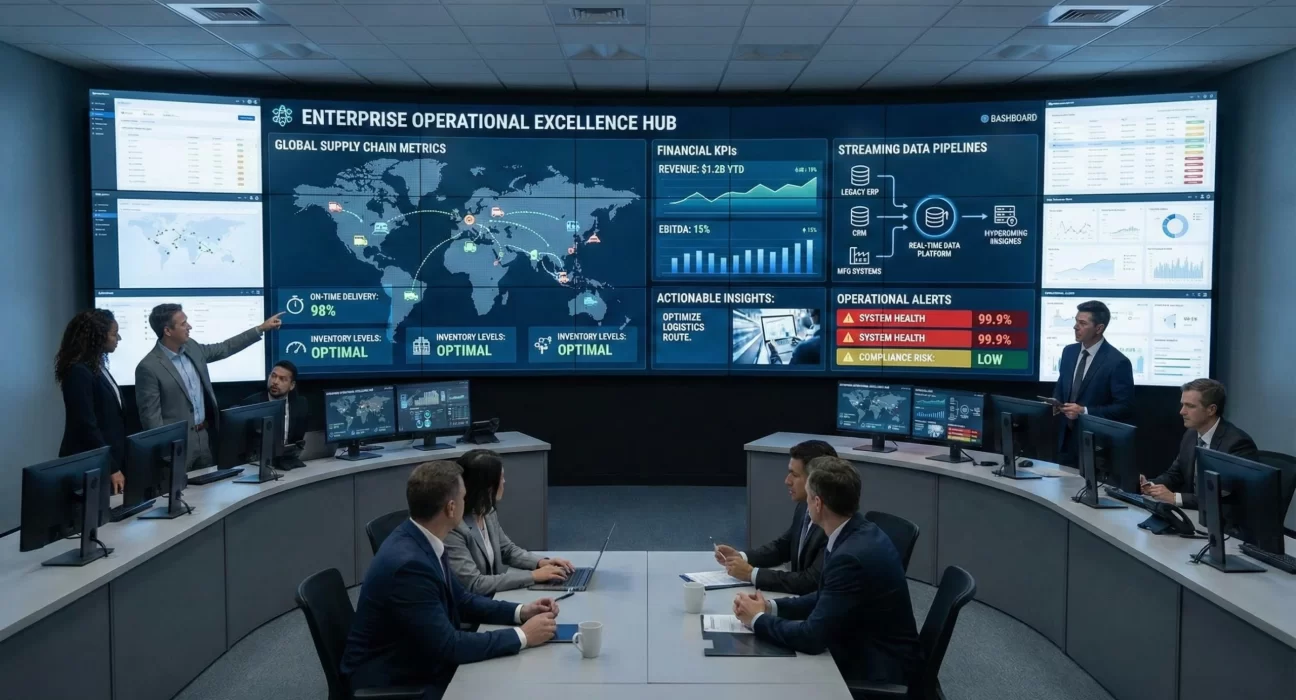
The promise is simple enough: give executives real-time data so they can make faster, better decisions. The reality? Most large enterprises are still struggling to get clean data from last quarter, let alone this morning.
If you’re a CIO or CTO reading this, you already know the gap between what the vendor demo showed and what your team actually delivered. You’ve sat through presentations where everything looked perfect on paper. Then six months in, the program is over budget, timelines have slipped, and the business is still running reports manually because the new system “isn’t quite ready yet.”
Real-time decision making isn’t just a technology problem. It’s an enterprise execution problem. And that’s exactly where most programs go wrong.
Why Real-Time Data Matters Now More Than Ever
Ten years ago, monthly reports were acceptable. Five years ago, weekly dashboards were competitive. Today, if your supply chain team is looking at yesterday’s inventory levels or your finance team is closing books based on two-week-old transaction data, you’re already behind.
Markets move faster. Customer expectations have changed. Competitors who can see and respond to signals in real-time are eating market share. This isn’t a theory anymore.
But here’s what nobody tells you in those glossy vendor presentations: building real-time data capabilities in a large enterprise is genuinely hard. Not hard like “we need more developers” hard. Hard like “we have seventeen legacy systems, three different ERP instances, compliance requirements across four countries, and a data governance framework that was designed when floppy disks were still common” hard.
The Real Challenges Nobody Talks About
Legacy Systems That Won’t Go Away
You can’t rip and replace a billing system that processes three million transactions a day. You can’t just “migrate” a manufacturing execution system that’s running production lines across twelve factories. These systems exist for a reason. They work, mostly. And the business risk of replacing them is often higher than the benefit of real-time data.
So you’re stuck integrating with them. Which means dealing with batch processes, proprietary formats, undocumented APIs, and that one critical system that only runs on a server in the basement that nobody wants to touch.
Data Quality Issues That Multiply at Scale
Real-time data pipelines are unforgiving. When you’re running batch processes overnight, you have time to catch errors, clean data, and fix issues before anyone sees the reports. When data is flowing in real-time, every quality issue becomes immediately visible.
Duplicate customer records, inconsistent product codes, transactions missing required fields all of this gets exposed. And suddenly your real-time dashboard is showing numbers that don’t match, and trust in the whole system evaporates.
Governance and Compliance Can’t Be Afterthoughts
C-level executives understand this instinctively: you cannot move fast and break things when you’re dealing with customer data, financial transactions, or regulated processes.
Every real-time data flow needs proper access controls, audit trails, data lineage, and compliance checks. In India, you’re likely dealing with RBI guidelines, data localization requirements, sector-specific regulations, and internal audit standards that were built for a different era.
Building real-time capabilities while maintaining governance isn’t optional. But it does mean your timeline just got longer and your architecture just got more complex.
The Vendor Landscape Is Confusing
The market is full of solutions. Cloud data platforms, streaming architectures, modern data warehouses, lake houses, mesh architectures every vendor has a story about why their approach is the future.
Some of these tools are genuinely good. But none of them solve your specific enterprise problem out of the box. You still need to design the architecture, integrate with existing systems, manage the migration, train the team, and operate it all reliably.
And here’s the trap: enterprises often pick vendors based on features and demos rather than on how well that vendor understands enterprise delivery realities. Six months later, you realize the vendor has never actually done an implementation at your scale, in your regulatory environment, with your constraints.
What Actually Works: Execution Over Technology
The enterprises that successfully build real-time data capabilities don’t do it because they picked the perfect technology stack. They do it because they executed well.
Start With Business Outcomes, Not Technical Architecture
Before you select any platform or hire any vendor, get crystal clear on what business decisions you’re trying to improve. Not “we want real-time data.” That’s not a goal.
Specific outcomes look like: “Reduce stock-outs in top-selling products by 20% by giving store managers real-time inventory visibility” or “Cut payment reconciliation time from five days to four hours so finance can close books faster.”
When you anchor the program to measurable business outcomes, every technical decision becomes easier. You can also spot scope creep early, because you know exactly what you’re trying to achieve.
Phase the Program Properly
Large-scale digital transformation programs fail when enterprises try to do everything at once. The urge to build the perfect, company-wide real-time data platform from day one is strong. Resist it.
Start with one high-value use case. Prove it works. Show business impact. Build confidence with stakeholders. Learn what actually works in your environment. Then expand.
This isn’t about thinking small. It’s about managing risk and building momentum. A successfully delivered Phase 1, even if it’s narrow, is worth ten perfectly designed Phase 1s that never go live.
Treat Data Engineering as a Core Discipline
Real-time data engineering isn’t something you can outsource entirely and forget about. It requires deep expertise, constant attention, and tight integration with business processes.
You need people who understand both the technology and your business. People who can troubleshoot a streaming pipeline at 3 AM and also explain to the CFO why the numbers look different in the new system.
This means investing in your internal team, not just hiring contractors. It means creating career paths for data engineers. It means giving them the tools and authority to make decisions.
Get Serious About Program Governance
Every enterprise says they have governance. What they usually have is a steering committee that meets monthly, reviews slides, and approves budget increases.
Real governance for complex technology programs means:
Daily or weekly standups with real accountability for deliverables. Clear decision rights so you’re not waiting two weeks for approvals on routine issues. Risk registers that people actually use and update. Escalation paths that work when things go wrong. Direct involvement from business stakeholders, not just IT.
When governance is tight, problems surface early when they’re still manageable. When it’s loose, you find out six months in that the integration nobody thought about is going to delay the whole program.
Choose Partners Who Understand Enterprise Delivery
Technology vendors are important. But you also need partners who understand enterprise program management, stakeholder management, and delivery at scale.
This is where companies like Ozrit make a difference. Not because they have magic technology, but because they’ve executed complex enterprise programs before. They know what goes wrong. They know how to structure delivery teams. They know how to manage timelines when you’re integrating with legacy systems that don’t always behave predictably.
The right partner doesn’t just write code. They help you navigate the organizational complexity, manage stakeholder expectations, build internal capability, and actually deliver on time and on budget.
The Hidden Costs Everyone Underestimates
When you budget for a real-time data platform, you typically account for software licenses, cloud infrastructure, and implementation services. What you don’t budget for and what ends up derailing programs are the hidden costs.
Change Management Is Expensive and Essential
Your business users have been working a certain way for years. They know how to use the old systems. They trust the old reports, even if those reports are slow and limited.
Introducing real-time data means changing workflows, retraining teams, and managing anxiety about new systems. If you don’t invest in change management, adoption will be slow and the business value you projected won’t materialize.
Technical Debt Compounds Quickly
When you’re under pressure to deliver, it’s tempting to take shortcuts. Skip proper documentation. Postpone that refactoring. Hard-code something that should be configurable.
In a real-time data system, technical debt is particularly dangerous because these systems run continuously. That quick fix you implemented in Phase 1 becomes a permanent bottleneck in Phase 3. You end up spending more time managing workarounds than building new capabilities.
Ongoing Operations Require Real Investment
Real-time systems don’t run themselves. Data pipelines break. Streaming jobs fail. Performance degrades. Security patches need to be applied.
You need monitoring, alerting, on-call rotations, and people who know how to fix issues quickly. This operational overhead is permanent. Budget for it from day one.
What Success Actually Looks Like
Successful real-time data programs share a few common characteristics that have nothing to do with which vendor you picked or which cloud you’re using.
They have executive sponsorship that goes beyond approving budgets. Someone senior is actively involved, removing roadblocks and making decisions.
They have realistic timelines that account for integration complexity, testing, data migration, and user training. Nobody is promising miracles in three months.
They measure progress based on business outcomes, not technical milestones. “We deployed the streaming platform” is not a success. “Supply chain team reduced forecast errors by 15%” is a success.
They build internal capability alongside delivery. Knowledge transfer isn’t a checkbox at the end of the project. It’s happening continuously throughout.
They manage stakeholder expectations honestly. When there’s a problem, it gets escalated quickly with options for resolution, not hidden until it becomes a crisis.
A Realistic Path Forward
If you’re considering a real-time data initiative, here’s what a pragmatic approach looks like:
Assess your current state honestly. Not where you want to be, where you actually are. What systems do you have? What data quality issues exist? What governance gaps need to be addressed?
Define one or two high-impact use cases that will deliver measurable business value in six to nine months. Not three years. Not three months. Something achievable that builds credibility.
Build a cross-functional team with clear ownership. Business stakeholders, data engineers, IT operations, security, compliance everyone who needs to be involved should be involved from the start.
Select technology partners and implementation partners who have actually done this before at enterprise scale. Ask for references. Talk to their previous clients. Understand what went wrong in those programs and how they handled it.
Companies like Ozrit, with experience in managing complex IT programs and enterprise execution challenges, can help you navigate this process without the usual false starts and expensive mistakes.
Plan for phases, not a big bang. Deliver incrementally. Show value continuously. Adjust based on what you learn.
Invest in the foundational work that isn’t exciting but is essential: data governance frameworks, data quality processes, operational runbooks, disaster recovery plans.
The Bottom Line
Real-time decision making is no longer a competitive advantage. It’s becoming table stakes. But getting there in a large enterprise requires more than buying the right technology.
It requires understanding that this is a program management challenge as much as it is a technology challenge. It requires honest assessment of where you are, realistic planning for where you’re going, and disciplined execution to actually get there.
The executives who succeed are the ones who resist the temptation to chase every new technology trend and instead focus on delivery fundamentals: clear objectives, proper governance, strong teams, realistic timelines, and partners who know how to execute.
Technology will evolve. The vendors will change. But the fundamentals of successful enterprise program delivery remain constant. Start there, and the technology choices become much simpler.