They don’t collapse overnight. They drift. Timelines extend from 18 months to 36. Budgets double. The scope gets redefined three times. And somewhere between the third steering committee meeting and the fifth vendor escalation, the original vision of secure, scalable, role-based access for 50,000 employees across 12 business units becomes a compromise no one is particularly proud of.
If you’re reading this, you’ve likely been in that room. The one where IT says the legacy system can’t be retired yet, the CISO says the new system isn’t compliant, finance wants to know why costs are 40% over, and the vendor is explaining why the next phase will solve everything.
Identity and access management at enterprise scale isn’t a technology problem. It’s a delivery problem. And most organisations discover this too late.
Why Enterprise IAM Programs Drift
Let’s start with what actually happens.
You approve a business case. The right words are in the deck: zero trust, least privilege, audit trails, compliance-ready. The vendor demonstrates a clean interface. The consultant’s roadmap looks logical. Everyone nods.
Six months in, you’re managing fourteen stakeholder groups with conflicting priorities. HR wants seamless onboarding. Legal wants irrefutable audit logs. Business unit heads want flexibility. IT wants to retire three legacy directories, but can’t until the new system proves itself. And proving itself means running both systems in parallel, which was meant to last four weeks but is now entering month seven.
This isn’t incompetence. It’s the nature of enterprise-scale identity programs. They touch everything. Every employee, every contractor, every application, every compliance requirement, every business process that involves a login.
The complexity isn’t in the technology. It’s in the coordination.
What Role-Based Security Actually Means at Scale
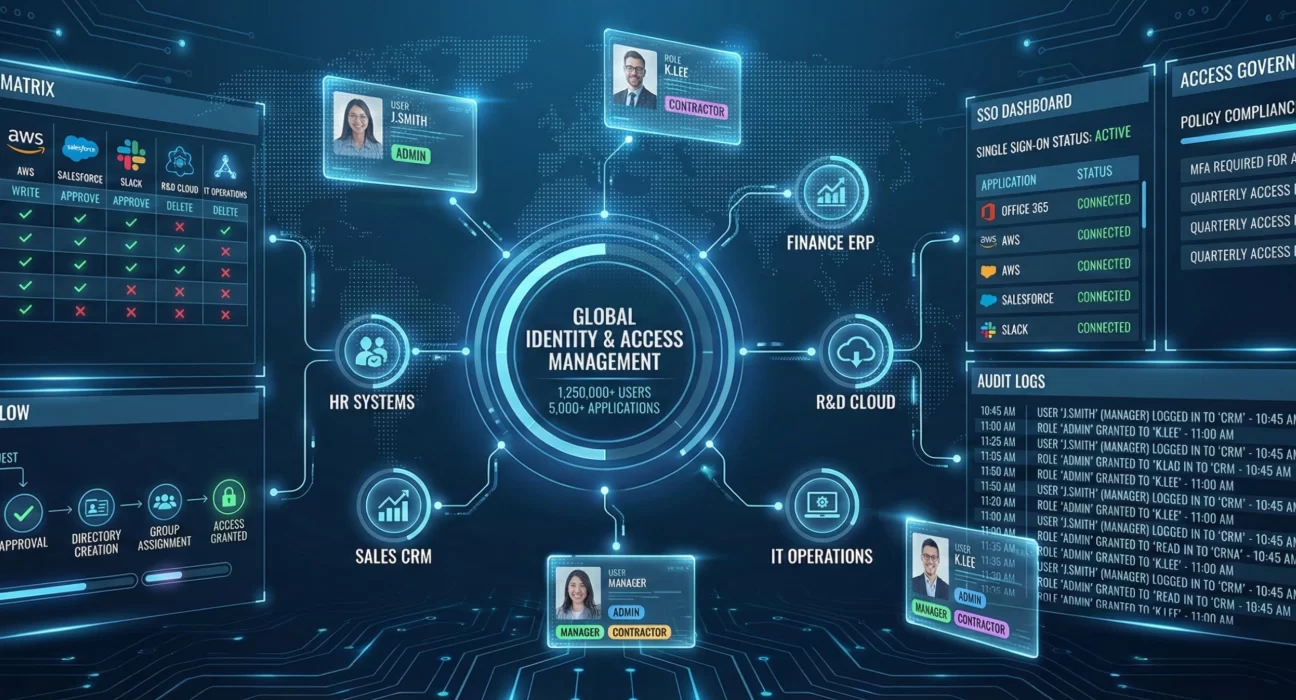
In theory, role-based access control is straightforward. You define roles, assign permissions, map users to roles, and maintain them over time.
In practice, you’re reconciling:
A sales manager in Mumbai who needs access to the CRM, the partner portal, and the expense system—but not the same CRM views as a sales manager in Singapore, because they operate under different regulatory frameworks.
A finance analyst who needs read access to twelve modules during month-end close, elevated access to three of those modules for four days every quarter, and audit trail oversight that satisfies both your internal policy and the external auditor who shows up twice a year.
An IT contractor hired through a third-party vendor who needs admin access to a specific environment for six weeks, and whose access must be revoked automatically when the contract ends, except when it gets extended at the last minute, which happens 40% of the time.
Now multiply that across thousands of roles, tens of thousands of users, and a dozen systems that were never designed to talk to each other.
The question isn’t whether your IAM platform can handle role definitions. The question is whether your organisation can define, govern, and maintain those roles without creating a compliance risk or an operational bottleneck.
The Execution Gap
Here’s what separates programs that deliver from programs that drift:
Ownership clarity. Most IAM programs fail because no one truly owns the outcome. IT owns the system. HR owns the data. Business units own the roles. Compliance owns the audit. The program manager owns the timeline. And when something breaks, when a contractor gets access they shouldn’t have, or a critical user can’t log in on day one, everyone points at someone else.
Successful programs assign end-to-end accountability. One leader. One throat to choke. Someone who wakes up thinking about whether the thing will actually work when you flip the switch.
Governance that actually governs. Most governance frameworks look impressive in PowerPoint. They have the right committees, the right escalation paths, and the right approval gates. Then you try to get a decision on whether to retire a legacy application, and the decision takes six weeks because three stakeholders are waiting for three other stakeholders, and no one has the authority to call it.
Real governance means decision rights are clear, and decisions happen on a clock. If the steering committee can’t decide in two meetings, the program lead decides and informs the committee. Otherwise, you’re managing by consensus, and consensus is how timelines die.
Delivery maturity. Technology vendors sell software. System integrators sell implementation hours. But enterprise programs need something else: partners who understand that delivery is about managing risk, sequencing decisions, and keeping twelve spinning plates from crashing.
This is where companies like Ozrit become relevant, not because they have a better IAM product, but because they treat enterprise delivery as the actual discipline it is. Program governance. Stakeholder management. Risk mitigation. Change management. The unglamorous work that determines whether your IAM program is still running two years after go-live.
The Questions Executives Should Be Asking
If you’re evaluating an IAM program or trying to get one back on track, here are the questions that matter:
Who owns this when it goes wrong? Not who manages it. Who owns the outcome? If you don’t have a clear answer, you have a problem.
What are we retiring, and when? Every new system at scale runs in parallel with something old. If you don’t have a hard date to turn off the old system, you’ll run both forever. And running both forever means you haven’t actually solved the problem, you’ve added cost and complexity.
How are we testing this before we bet the business on it? Role-based access isn’t something you can pilot with 50 users and then scale to 50,000. The edge cases, the conflicts, and the performance issues show up at scale. If your testing strategy doesn’t simulate realistic load and realistic role complexity, you’re going to discover your gaps in production.
What happens when someone leaves the organisation on a Friday afternoon? Access revocation sounds simple until you map out the actual process. Who initiates it? How does it propagate across systems? What’s the SLA? If someone gets terminated for cause, can you guarantee their access is gone within the hour? These aren’t hypothetical questions. They’re audit questions. And if you don’t have clean answers, your auditor will find out before you do.
What’s our plan for the next ten years? Enterprise IAM isn’t a project. It’s a capability you’ll operate indefinitely. That means your design needs to account for M&A, new regulatory requirements, new applications, and new business models. If you’re building something that solves today’s problem but can’t adapt to tomorrow’s, you’re buying yourself a replacement program in five years.
The Hidden Costs of Getting This Wrong
Budget overruns get attention. But the real cost of a failed IAM program isn’t the extra money you spend. It’s the risk you carry and the opportunities you miss.
When your access controls are fragile, you can’t move fast on M&A. Integrating a new subsidiary means months of manual reconciliation and elevated risk.
When your audit trail isn’t trustworthy, you can’t confidently enter new regulated markets. The compliance team says no because they can’t prove controls are working.
When provisioning takes three weeks, you can’t scale your sales team as fast as the market demands. New hires sit idle or work with temporary guest access that makes your CISO nervous.
And when you’re running three overlapping identity systems because you couldn’t retire the old ones, you’re spending money and management attention on infrastructure instead of innovation.
The cost of poor execution isn’t just financial. It’s strategic. It’s the drag on everything else you’re trying to do.
What Good Execution Looks Like
The programs that work and some share certain characteristics:
They start with clarity about what success looks like. Not a vision statement. A specific, measurable definition. “Every employee and contractor has appropriate access provisioned within one business day of their start date, and revoked within one hour of termination, with full audit trail, across all core systems.” That kind of clarity.
They sequence the work to reduce complexity, not add to it. Phase one isn’t “build the new thing.” Phase one is “get the data clean and establish the governance.” Because if your role definitions are a mess and your data quality is poor, the new system will just automate the mess.
They treat change management as engineering, not communications. It’s not about the town halls and the newsletters. It’s about redesigning business processes so they work with the new system. Training the people who approve access requests. Building runbooks for the service desk. Making sure the thing is actually usable by the people who have to use it every day.
They choose partners based on delivery capability, not just technical capability. The vendor with the best product demo isn’t always the vendor who can navigate your organisation’s politics, manage your legacy constraints, and actually get the thing live.
And they maintain relentless focus on the outcome. When scope creeps, and it will, they ask whether the new requirement is essential to the core objective or a nice-to-have that can wait for phase two. When timelines slip, they will make hard choices about what gets cut or descoped rather than just extending the deadline.
The Role of the Right Partner
Enterprise delivery at scale requires a different kind of partner. Not someone who sells you technology and walks away. Not someone who implements a statement of work and declares success when the contract ends.
You need someone who stays in the game. Who understands that go-live is the beginning, not the end. Who knows that the real test of an IAM program is whether it’s still delivering value and still under control eighteen months after launch.
This is where execution-focused partners add value. They’ve seen what breaks. They know which governance models actually work and which ones look good in theory but collapse under real-world pressure. They understand that enterprise software delivery is as much about managing people and process as it is about configuring systems.
When Ozrit engages with enterprise clients on complex programs, the conversation starts with delivery, not technology. What are the real constraints? Who are the real stakeholders? What are the real risks? And then: what’s the execution plan that gives this the best chance of working?
It’s not glamorous. But it’s what separates programs that deliver from programs that drift.
Getting From Here to There
If you’re leading an enterprise and you’re looking at IAM as a strategic priority or if you’re already mid-program and it’s not going the way you expected, the path forward isn’t mysterious.
Get clear on ownership. One person. End-to-end accountability.
Get clear on scope. What are you actually trying to achieve, and what can wait?
Get clear on governance. Who decides what, and how fast can they decide it?
Get clear on the exit plan for legacy systems. If you’re not retiring something, you’re just adding complexity.
And get clear on who you’re partnering with. Do they understand enterprise delivery? Have they done this before? Will they still be around when things get hard?
The technology will work. Modern IAM platforms are mature. The question is whether your organisation can execute the program. Whether you can navigate the politics, manage the stakeholders, sequence the work, maintain the momentum, and actually get it live.
That’s not a technology question. It’s a leadership and execution question.
And it’s the question that determines whether your IAM program becomes a strategic enabler or another expensive, half-finished compromise that everyone learns to work around.