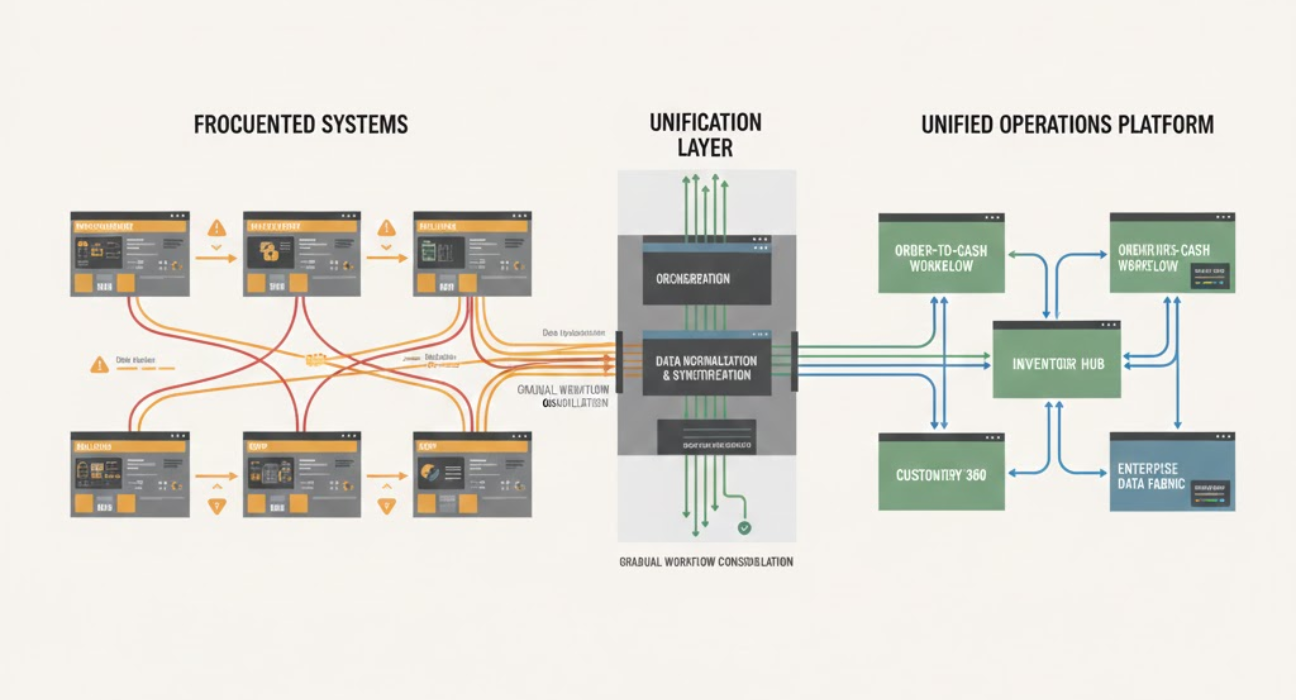
Large enterprises run on collections of systems that were never meant to work together. The procurement system came from one vendor. The inventory platform from another. The workflow engine from a third party. Each system made sense at the time it was purchased. Each solved a specific problem. But together, they create an operational environment that is expensive, fragile, and difficult to change.
Data lives in multiple places with no single source of truth. A customer record exists in the CRM, the billing system, the support platform, and the warehouse management system, often with conflicting information. When something changes, updates must propagate across all systems manually or through fragile integrations that break regularly.
Processes span multiple systems with handoffs that require human intervention. An order starts in the e-commerce platform, moves to the order management system, touches the inventory system, goes to the warehouse system, and ends in the billing system. Each transition is a point where things can fail or get delayed. Visibility is poor because no single system shows the complete picture.
This fragmentation costs money in obvious and hidden ways. Integration maintenance consumes IT resources. Manual workarounds consume operational resources. Poor data quality creates errors that require correction. Lack of visibility means problems are discovered late, when they are expensive to fix. The total cost is difficult to quantify but clearly substantial.
Why Fragmentation Became the Default
Most operational environments evolved through decades of technology decisions made for good reasons at the time. The company needed a new procurement system in 2010, so they bought best-of-breed software. Manufacturing needed better planning tools in 2013, so they implemented a specialised solution. Finance wanted improved controls in 2016, so they added workflow management.
Each decision was rational in isolation. The organisation selected strong products that addressed specific needs. But no one was designing the overall architecture. No one was ensuring these systems would work together cleanly. The enterprise application integration strategy assumed custom middleware could connect everything, which proved far more expensive and fragile than expected.
Acquisitions made things worse. Each acquired company brought its own systems. Consolidating them seemed too expensive or risky, so they stayed in place. Now the organisation has three different order management systems, two inventory platforms, and four procurement tools, each serving different parts of the business.
The result is an operational environment that works but barely. It requires extensive manual coordination. It is difficult to change because everything is interconnected in complex ways. It is expensive to maintain because each system requires its own expertise, licensing, and infrastructure. And it cannot support the capabilities the business needs next, like real-time operational visibility or intelligent automation.
The Hidden Costs That Add Up
Fragmented systems create costs that are hard to see in any single budget line but accumulate across the organisation.
Integration maintenance consumes significant IT capacity. Each connection between systems requires monitoring, updating, and troubleshooting. When one system changes, integrations must be updated. When performance degrades, someone must diagnose whether the problem is in system A, system B, or the integration between them. A large enterprise might have hundreds of integrations, each requiring ongoing attention.
Data quality problems multiply across fragmented environments. When the same information exists in multiple places, inconsistencies develop. Which system has the correct customer address? Which has the current pricing? Resolving these conflicts requires manual effort and still results in decisions based on unreliable data. The business makes worse decisions because it cannot trust its own information.
Process inefficiency becomes embedded in how work happens. When a process spans five systems, people develop workarounds to bridge the gaps. They keep information in spreadsheets. They send emails to coordinate handoffs. They manually check status across systems. This hidden work is rarely measured but consumes substantial time that could be spent on higher-value activities.
Change becomes expensive and slow. Adding a new product line means updating multiple systems. Entering a new market means extending integrations to new regions. Acquiring a company means connecting its systems to the existing fragmented environment. Each change takes longer and costs more than it should because the technical foundation is complex and brittle.
The opportunity cost might be the largest impact. Strategic initiatives stall because the operational platform cannot support them. The business cannot offer capabilities that customers want because the systems cannot deliver them. Competitors with more modern platforms move faster and serve customers better.
Why Unification Efforts Often Fail
Many organisations recognise the fragmentation problem and attempt to solve it. They launch enterprise-wide platform consolidation programs. These initiatives usually follow a predictable pattern and often fail for similar reasons.
The program starts with ambitious goals. Replace all fragmented systems with a single integrated platform. Deliver comprehensive capabilities. Achieve significant cost savings. The timeline looks aggressive but achievable. The budget seems adequate based on vendor proposals.
Then reality intrudes. Requirements are more complex than anyone understood. Different business units have genuine needs that conflict. The selected platform cannot handle certain processes without extensive customisation. Integrations with systems that cannot be replaced prove more difficult than expected. Data migration reveals quality issues that must be resolved before proceeding.
The program extends. Costs increase. Scope gets negotiated. Some capabilities get deferred. Some business units get exempted. What was supposed to be a unified platform becomes a partial consolidation that still requires many of the old systems to remain operational. The organisation ends up with higher costs, more complexity, and stakeholders who lost confidence in technology leadership.
The failure often comes from underestimating the genuine complexity of enterprise operations and overestimating what a commercial platform can deliver without significant adaptation. Vendors demonstrate impressive capabilities, but the demo environment is simpler than the real operational environment. What works in the demo requires months of configuration and custom development to work in production.
How Ozrit Approaches Unification Differently
Ozrit designs unified operations platforms based on understanding what actually causes fragmentation and what it takes to replace fragmented systems successfully. The company was founded by people who led these programs at large enterprises and learned from both successes and failures.
The platform architecture uses a composable design rather than a monolithic structure. Instead of trying to replace every system with a single massive platform, Ozrit builds a unified operational layer that can integrate cleanly with systems that must remain, while replacing systems that should be consolidated. This allows incremental transition rather than requiring a complete replacement all at once.
The data model establishes a single source of truth while acknowledging that some data will continue residing in specialised systems. The platform maintains authoritative records for core operational entities like orders, inventory, and customers, while synchronising with external systems that need this information. This creates consistency without requiring every system to be replaced immediately.
Process orchestration spans across systems in a way that provides visibility and control even when work touches multiple platforms. A business process might involve the Ozrit platform for workflow and coordination, an existing ERP for financial transactions, and a specialised system for manufacturing scheduling. The Ozrit platform coordinates these systems, manages handoffs, and provides unified visibility into process status.
This approach reduces risk by allowing the organisation to move incrementally. Critical systems can remain in place while fragmented systems get consolidated progressively. Each phase delivers value and reduces complexity without requiring everything to change simultaneously.
The Assessment That Determines Feasibility
Ozrit begins unification programs with a structured assessment that typically runs six to eight weeks. This is longer than typical vendor assessments because the goal is to understand actual operational complexity, not just document high-level requirements.
Senior Ozrit engineers work directly with operational teams to map how work really happens. They identify which systems are involved in each process, where handoffs occur, where data conflicts arise, and where people have developed workarounds. They analyse integration patterns to understand dependencies. They evaluate data quality to determine migration challenges.
The assessment produces a realistic view of what unification requires. It identifies which systems can be retired relatively easily and which create complex dependencies that must be addressed carefully. It quantifies the current cost of fragmentation in concrete terms like integration maintenance hours, manual coordination time, and error correction effort. It estimates the effort required for different consolidation scenarios with confidence levels based on actual complexity.
This assessment sometimes reveals that full unification is not the right answer. Perhaps certain specialised systems provide genuine value and should remain. Perhaps the priority is consolidating customer-facing operations while leaving back-office systems fragmented for now. The assessment supports informed decisions about scope and approach rather than assuming one solution fits every situation.
Implementation That Manages Risk
Ozrit structures unification programs in phases that each deliver tangible value and reduce operational complexity. The first phase typically focuses on establishing the unified platform and migrating the highest-value processes from fragmented systems. This creates a working foundation that handles real operations while proving the platform can deliver.
Subsequent phases progressively migrate additional capabilities and retire legacy systems. The sequence considers both business value and technical dependencies. High-impact processes that are relatively straightforward to migrate come early. Complex processes with many dependencies come later after the platform has proven itself and the team has gained experience.
Each phase includes comprehensive testing and parallel operation before cutover. New capabilities run alongside old systems until the organisation confirms they work reliably. This costs more in the short term but dramatically reduces the risk of operational disruption. When cutover happens, confidence is high because the new approach has been thoroughly validated.
A realistic timeline for meaningful unification is 12 to 18 months for programs that consolidate core operational systems, or 18 to 24 months for comprehensive programs that address the full operational environment. These timelines assume reasonable organisational decision-making and resource allocation. Delays typically come from change management challenges or infrastructure constraints rather than technical delivery issues.
Ozrit assigns senior technical leaders to unification programs because the decisions about architecture, migration sequence, and integration patterns have long-term implications. An experienced architect ensures these decisions create a sustainable platform rather than just replacing one form of complexity with another. They stay involved throughout delivery, not just during planning.
Managing Organisational Change
Unification requires more than technical implementation. People work differently when processes change. Roles shift as automation replaces manual coordination. Skills need development as people move from fragmented tools to a unified platform.
Ozrit addresses these dimensions explicitly rather than treating them as afterthoughts. Change management begins during assessment as teams learn what is coming and why. Training develops before go-live so people are prepared when new capabilities launch. Support resources are available during transition periods when questions are common and confidence is building.
The organisational challenge often centers on business units that adapted fragmented systems to their specific needs. They worry that a unified platform will remove the flexibility they depend on. Addressing this requires showing how the unified platform accommodates their genuine requirements while eliminating inefficiency and fragmentation. Sometimes it means phasing their transition later, after the platform proves itself with other groups.
Governance becomes critical during unification. Decisions about process standardisation, data ownership, and system retirement affect multiple stakeholders. Without clear authority and decision rights, unification programs stall in endless negotiation. Ozrit helps establish governance structures that enable timely decisions while ensuring appropriate input from affected parties.
The Economics of Unification
Unifying fragmented systems requires significant upfront investment. Platform costs, implementation services, infrastructure, internal resources, and organisational change all consume budget. For a large enterprise, the total program cost might reach tens of millions over the implementation period.
The justification comes from comparing the total cost of ownership between the fragmented environment and the unified platform over multiple years. Fragmented systems incur integration maintenance costs, license fees for multiple products, infrastructure for many platforms, and operational costs from inefficiency. These costs continue and often increase year after year.
A unified platform consolidates these costs. Integration maintenance drops significantly. License fees decrease as systems are retired. Infrastructure consolidates. Operational efficiency improves. The unified platform also enables capabilities that fragmented systems cannot support, creating value beyond cost reduction.
The payback period typically runs two to four years, depending on the scale of fragmentation and the efficiency gains achieved. After payback, the unified platform provides ongoing savings and strategic flexibility that compounds over time.
Support for the Unified Environment
Once the unified platform is operational, it requires ongoing support and continuous improvement. Ozrit provides 24/7 support with access to senior engineers who understand the platform architecture and the business context. When issues arise, response comes from people who can diagnose and resolve problems effectively.
The platform evolves as business needs change. New products require new capabilities. Process improvements get implemented based on operational experience. Integration with new systems gets added as needed. Ozrit structures engagements to include this ongoing development capability rather than treating unification as a project that ends at go-live.
Regular business reviews assess whether the unified platform is delivering expected value and identify opportunities for further improvement. These reviews involve both Ozrit and client leadership, focusing on business outcomes and strategic alignment rather than technical details.
What Unified Operations Enable
A well-executed unified platform creates capabilities that fragmented systems simply cannot provide. Real-time visibility across all operations becomes possible. Intelligent automation can optimise across processes rather than within isolated systems. Data quality improves dramatically when there is a single authoritative source. Changes can be implemented quickly because they happen in one place rather than across many systems.
These capabilities translate to a competitive advantage. Faster operations. Better customer experience. Lower costs. Greater agility. The organisation that successfully unifies its operational platform positions itself to adapt and compete more effectively than competitors still struggling with fragmentation.