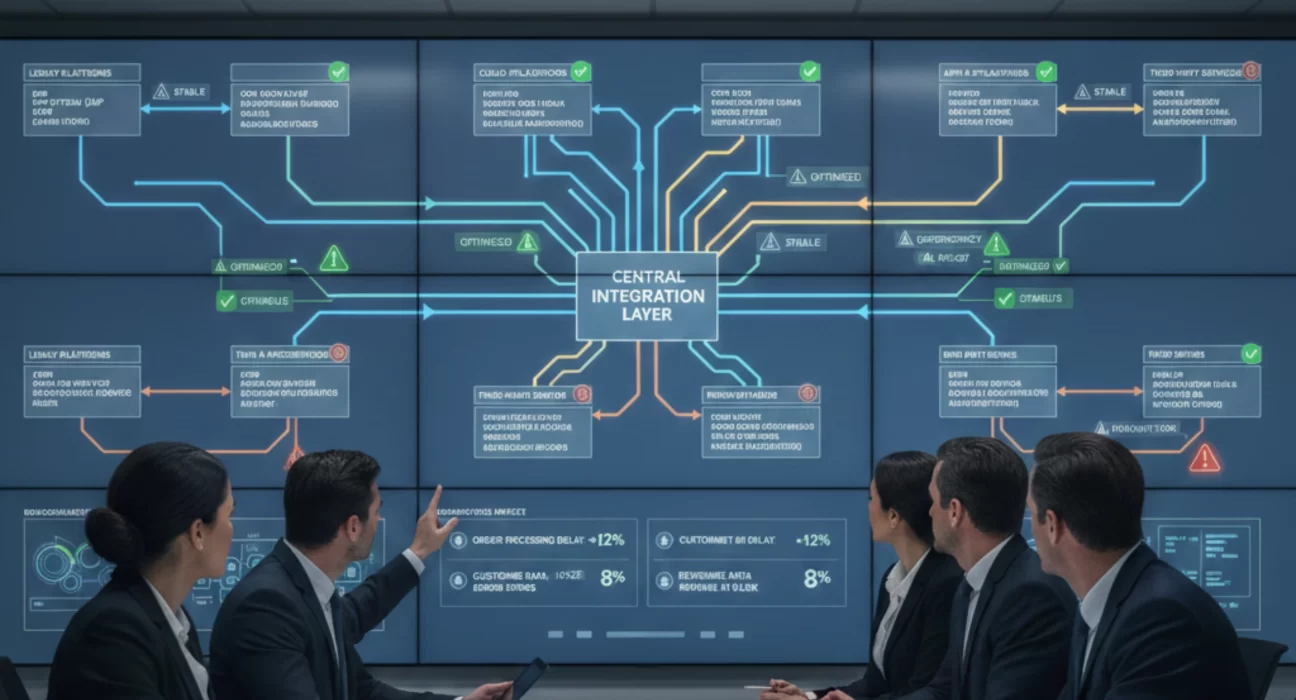
Every enterprise initiative depends on integration. New customer experiences need data from legacy systems. Digital transformation requires connecting modern applications to decades-old infrastructure. Business process improvements rely on information flowing between departments and platforms. The integration layer that connects these systems either enables the business to move forward or becomes the constraint that holds everything back.
Most executives understand integration matters, but few recognize how profoundly it affects business outcomes. A well-designed integration layer accelerates every initiative, reduces operational costs, and enables capabilities that would otherwise be impossible. A poorly designed one creates bottlenecks, generates cascading failures, and makes simple changes expensive and risky. The difference in business value between these two scenarios is enormous.
The challenge is that integration complexity grows exponentially as enterprises scale. Connecting five systems is manageable. Connecting fifty systems with hundreds of integration points becomes genuinely difficult. And most large enterprises have integration requirements far beyond that, with systems spanning multiple decades of technology, distributed across regions, and owned by different business units with different priorities.
The Hidden Cost of Bad Integration
Poor integration shows up in ways that aren’t always recognized as integration problems. Projects take longer than planned because integration work is consistently underestimated. Features launch with missing functionality because certain integrations couldn’t be completed in time. Customer experiences break because upstream systems changed without coordination. Operations teams spend their time investigating data inconsistencies that stem from integration failures.
The financial impact is substantial but often hidden in project overruns and operational inefficiency. A retail initiative that should take six months takes fourteen months, largely due to integration complexity. A customer service improvement that promised cost savings actually increases costs because integrations require constant manual intervention. A new product launch gets delayed because inventory systems can’t be integrated in time.
These problems compound over time. Each new system requires integration with existing systems, and the effort increases with the number of existing integration points. What started as a manageable integration challenge becomes a web of connections that nobody fully understands. Changes become risky because it’s unclear what might break. And the enterprise becomes progressively less agile because every initiative requires navigating this complexity.
Point-to-Point Integration Debt
Most enterprise integration problems stem from point-to-point connections built over the years as individual needs arose. System A needs data from System B, so someone builds a direct connection. System C also needs that data, so another direct connection gets built. Eventually, you have dozens of systems with hundreds of direct connections, each implemented slightly differently, each with its own failure modes.
This approach is logical when you’re solving individual problems, but it creates technical debt that becomes crippling at scale. Nobody has a complete picture of how data flows through the enterprise. Changes to one system require identifying and updating all the systems connected to it. Data transformations happen inconsistently across different integration points, leading to data quality problems. And when something breaks, troubleshooting requires tracing through multiple hops of integrations to find the source.
The typical enterprise response is to implement an integration platform or enterprise service bus. These tools help manage the complexity, but they don’t solve the fundamental problem of unclear data ownership, inconsistent transformation logic, and fragmented governance. They just move the complexity from individual connections to a centralized platform that still requires careful design and ongoing maintenance.
The Data Consistency Problem
Integration complexity creates data consistency problems that affect every part of the business. Customer data exists in multiple systems with different values. Product information is inconsistent across channels. Order status updates don’t propagate correctly. Inventory counts diverge between systems. Financial reports show different numbers depending on which system generated them.
These inconsistencies aren’t just technical annoyances. They directly affect business operations and customer experience. Sales teams waste time reconciling conflicting data. Customers see different information depending on which channel they use. Operations teams make decisions based on incorrect information. And trust in data erodes across the organization because everyone has encountered situations where the numbers don’t match.
The root cause is usually that different systems have different concepts of truth and different update patterns. The e-commerce platform updates customer addresses immediately. The fulfillment system syncs those changes overnight. The CRM system pulls updates weekly. When a customer changes their address and then immediately places an order, which address gets used? The answer depends on timing and which system processes the order first.
Solving this requires more than technical solutions. It requires clear data governance that defines authoritative sources for different types of data, acceptable latency for updates, and processes for handling conflicts. Most enterprises lack this governance, so they deal with consistency problems reactively as they arise rather than preventing them systematically.
Real-Time Versus Batch Integration
Many enterprise integration challenges come down to conflicting requirements between real-time and batch processing. Customer-facing systems need real-time data access for a good user experience. Backend systems were designed for batch processing and can’t handle real-time query loads. Marketing wants real-time personalization. The data warehouse updates nightly.
The tension between these requirements creates difficult tradeoffs. Building real-time integrations to legacy systems that weren’t designed for this load can cause performance problems or system instability. Using batch integration means customer-facing systems show stale data. Caching helps, but introduces consistency problems. And any solution that works well enough usually requires significant custom development and ongoing maintenance.
Enterprises often underestimate how difficult it is to add real-time capabilities to systems designed for batch processing. The database schemas weren’t optimized for real-time queries. The application logic wasn’t designed to handle high request volumes. The infrastructure wasn’t scaled for this usage pattern. What seems like a simple API layer actually requires substantial architectural changes to support reliably.
The result is that many enterprises have fragile real-time integrations that work most of the time but fail under load or in edge cases. These failures cascade into customer-facing systems, causing errors, timeouts, and poor experiences. And because the underlying systems weren’t designed for this usage, fixing the problems requires either accepting limitations or undertaking expensive modernization programs.
API Strategy and Reality
Most enterprises have invested in API strategies as a way to manage integration complexity. APIs provide consistent interfaces, enable reusability, and support modern application architectures. In theory, once you have good APIs, integration becomes straightforward.
In practice, enterprise API implementations often fall short of this vision. APIs get built to serve specific use cases without considering broader reusability. Different teams build APIs with inconsistent patterns and conventions. APIs expose underlying system complexity rather than providing clean abstractions. Documentation is incomplete or outdated. And nobody has clear ownership of API quality or evolution.
The result is that enterprises have dozens or hundreds of APIs that are difficult to discover, understand, and use correctly. Integration still requires significant custom development for each use case. Changes to APIs break consuming applications because versioning and backwards compatibility weren’t properly designed. And the promised reusability doesn’t materialize because each API was optimized for one specific consumer.
A good API strategy requires more than just building APIs. It requires governance around API design patterns, comprehensive documentation, clear ownership and support models, proper versioning and lifecycle management, and treating APIs as products that need ongoing investment. Most enterprises have the technical capability to build APIs but lack the organizational practices to make them truly valuable.
The Cost of Integration Middleware
Integration platforms and middleware were supposed to solve enterprise integration challenges. They provide tools for connecting systems, transforming data, managing workflows, and monitoring integration health. Many enterprises have invested millions in these platforms.
Yet integration remains a major bottleneck and cost center. Why? The platforms solve technical connectivity problems but don’t address the underlying architectural and organizational issues. They make it easier to build integrations, but they don’t prevent poorly designed integrations. They provide monitoring, but they don’t prevent the complexity that makes systems fragile.
More problematically, these platforms often become single points of failure and performance bottlenecks. All integration traffic flows through them, so any performance issue or outage affects multiple systems. They require specialized expertise to configure and maintain. They add latency to every integration because of the additional hop. And they can become expensive to scale as integration volumes grow.
The enterprises getting value from integration platforms are those that use them as part of a broader integration strategy, not as a complete solution. They have clear integration patterns and governance. They design platform-agnostic APIs so they’re not locked in. They architect for failure and ensure the integration layer doesn’t become a single point of failure. And they invest in the organizational capabilities needed to manage integrations well, not just the technology.
How Ozrit Approaches Enterprise Integration
At Ozrit, we’ve delivered integration programs for large enterprises across multiple industries. Our approach is based on understanding that integration is as much an organizational challenge as a technical one.
We start with a comprehensive assessment of your integration landscape. This goes beyond cataloging systems and connections. We examine data flows, identify consistency issues, assess performance characteristics, and understand the governance and ownership structures. This assessment typically takes four to six weeks and involves our senior architects working with teams across your organization.
The goal is to understand not just what integrations exist, but why they were built the way they were and what business outcomes they’re supposed to enable. This context is essential because integration solutions that ignore business requirements or organizational realities won’t succeed.
Based on this assessment, we develop an integration strategy that balances short-term needs with long-term sustainability. This typically includes rationalizing existing integrations, establishing clear patterns and standards, defining data governance, and building reusable integration capabilities. We structure the work in phases that deliver business value while progressively reducing integration complexity and technical debt.
Each integration program has a dedicated senior delivery lead from our team who owns the end-to-end execution. This person isn’t just managing. They’re an experienced integration architect who has designed and built enterprise integration layers before. They understand the tradeoffs between different approaches and can navigate both the technical complexity and the organizational challenges. They work alongside our team of 250+ developers and specialists to ensure consistent quality and progress.
Our onboarding process gets teams productive quickly on integration work. We assign engineers who have deep experience with enterprise integration patterns, API design, data transformation, and the specific platforms and technologies in your environment. They spend their first two to three weeks understanding your systems, data models, and business requirements. By week four, they’re delivering working integrations.
We handle the complex integration work that many enterprises struggle with. Building resilient APIs that handle failures gracefully. Implementing data transformation logic that maintains consistency. Designing for performance at scale. Managing versioning and backwards compatibility. Our engineers have done this work at multiple enterprises and know the patterns that work and the pitfalls to avoid.
Because we operate across time zones with 24/7 coverage, we can maintain momentum on integration programs and respond quickly when integration issues affect business operations. Integration problems often have a broad impact because so many systems depend on them. Having experienced engineers available around the clock means critical issues get addressed immediately rather than waiting for the next business day.
Our typical integration programs show measurable progress within three to four months, with initial integrations live and delivering value. Full integration layer modernization typically takes 12 to 18 months, depending on scope and complexity. These timelines reflect the reality of enterprise integration work and allow for proper design, testing, and migration of critical systems.
Integration as Competitive Advantage
The enterprises that move fastest aren’t necessarily those with the newest technology. They’re the ones that can integrate systems quickly and reliably, enabling new capabilities without getting bogged down in integration complexity.
This capability comes from treating integration as a strategic capability requiring investment in architecture, governance, and organizational skills. It means having clear patterns and standards that make integration predictable. It means having reusable components that accelerate new integrations. It means having monitoring and operational practices that catch problems before they affect the business.
When integration is done well, it becomes invisible. New initiatives launch on schedule because integration doesn’t become a bottleneck. Customer experiences work reliably because integrations are resilient. Operations teams focus on business problems rather than data inconsistencies. And the business can move quickly because integration capability scales with need rather than becoming progressively more difficult.
The integration layer is the infrastructure that either enables or constrains everything else. The enterprises that recognize this and invest accordingly gain compounding advantages over time, while those treating integration as just another technical problem continue struggling with the same issues year after year.