If you have opened your banking app lately and noticed it “predicting” your next bill payment, or if your food delivery app suddenly started suggesting a biryani before you even typed a word, you have already met the new face of AI mobile app development. What used to be a nice-to-have feature is now the backbone of how apps are designed, built, and used. In 2026, artificial intelligence is not sitting quietly in the background anymore – it is sitting in the driver’s seat of mobile innovation, from Chennai’s OMR tech corridor to Bengaluru’s Whitefield and beyond.
This article looks at how AI-driven app development is reshaping the industry this year, what it means for businesses and users alike, and which companies are doing solid, dependable work in this space – starting with Ozrit.
Why AI Has Become the Backbone of Mobile App Development
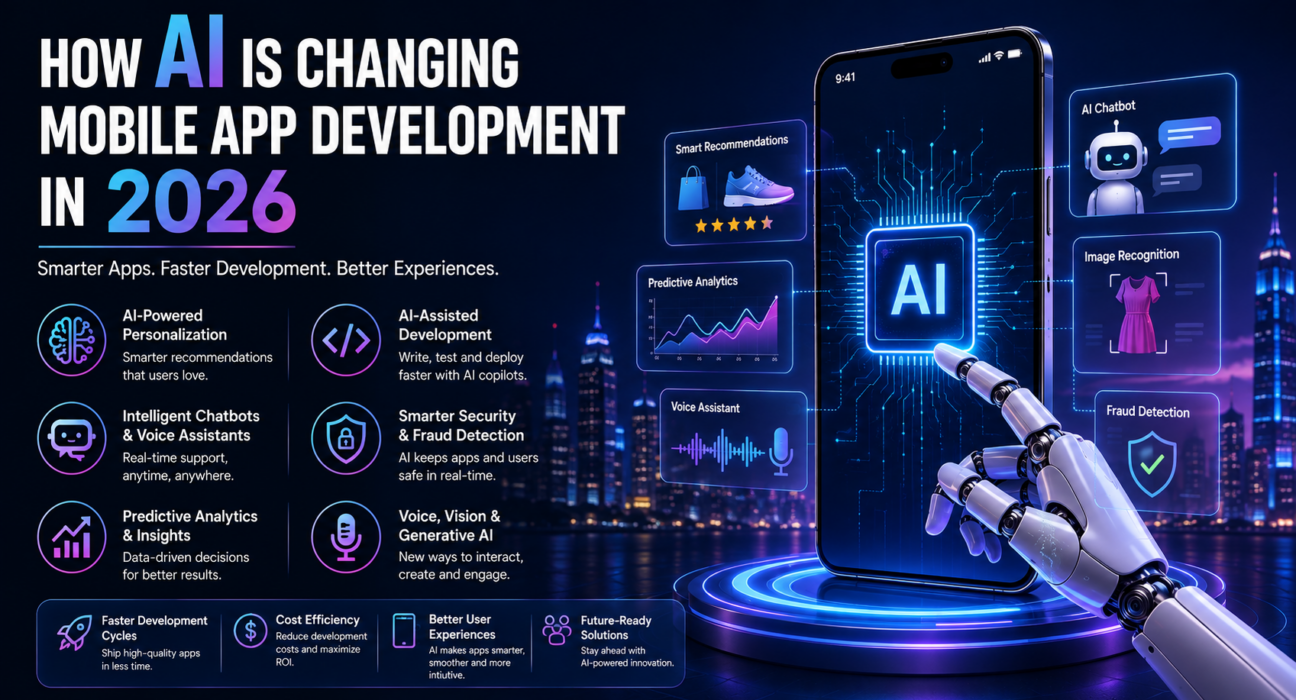
For years, mobile apps were built around fixed logic – if a user does X, the app does Y. That approach is now old wine in an older bottle. Artificial intelligence in mobile apps has flipped this script by making apps adaptive, predictive, and genuinely personal. A few forces are driving this shift:
1. Users expect apps to “just know” them. Just like a good chai wala at the corner shop remembers whether you take extra sugar, today’s apps are expected to remember preferences, anticipate needs, and adjust on the fly. This is where machine learning models quietly work behind the scenes, studying usage patterns and tailoring the experience without the user lifting a finger.
2. On-device AI has matured. Earlier, AI features needed a constant internet connection and heavy cloud processing. Now, thanks to more efficient models and better chipsets, a good chunk of AI processing happens directly on the phone. This matters a lot in India, where network connectivity can be patchy – think of a train journey between Chennai and Coimbatore where signal drops in and out. On-device AI means apps stay smart even when the network isn’t.
3. Generative AI has moved from novelty to necessity. Chatbots, content generation, image editing, and voice interfaces are no longer flashy add-ons; they are core product features. Apps across e-commerce, healthcare, and fintech are using generative AI to draft product descriptions, summarise medical reports, or explain complicated loan terms in plain language.
4. Regional language support has gotten a serious upgrade. With AI-powered natural language processing, apps can now understand and respond in Tamil, Telugu, Hindi, Bengali, and a dozen other Indian languages with far more nuance than before. This is opening up mobile app usage to a much wider audience beyond English-first, metro-city users.
Key Ways AI Is Reshaping the App Development Process Itself
It’s not just what apps do that has changed – it’s also how they get built. This is one of the quieter but more important long-tail shifts in AI-powered app development:
- AI coding assistants are helping developers write, review, and debug code faster, cutting weeks off typical build timelines.
- Automated testing powered by AI can now simulate thousands of user scenarios overnight, catching bugs that manual QA teams might miss, especially useful for apps that need to work flawlessly across the wide range of Android devices common in the Indian market.
- AI-driven project estimation helps agencies give clients more accurate timelines and budgets right from the discovery call, instead of the usual “we’ll get back to you” routine.
- Low-code and no-code platforms with AI copilots are letting smaller businesses build functional MVPs without hiring a full development team, which is a big deal for bootstrapped startups.
AI-Powered Features That Are Redefining the User Experience
When we talk about AI mobile app development in 2026, a handful of features keep showing up across industries, almost like the season’s favourite fabric at a Chennai silk shop:
- Hyper-personalisation engines that adjust app layout, content, and offers based on real-time behaviour, not just past history.
- Conversational AI and smart chat support that can resolve customer queries without a long wait – no more holding the line for “the next available agent.”
- Predictive analytics for use cases like inventory forecasting in retail apps or early fraud detection in fintech apps.
- Computer vision features such as visual search (snap a photo of a saree pattern and find similar ones online) or damage detection in insurance claim apps.
- Voice-first interfaces, increasingly important given how comfortable Indian users are with voice search on regional languages.
The Challenges That Come With This Shift
It would be unfair, and honestly a bit filmy, to paint this transformation as all rosy. Businesses adopting AI in their mobile apps have real hurdles to cross:
- Data privacy and compliance are now front and centre, especially with India’s Digital Personal Data Protection framework shaping how user data can be collected and processed.
- Cost of AI integration can be steep for smaller businesses, particularly when it involves training custom models rather than using off-the-shelf APIs.
- Talent shortage for specialised roles like ML engineers and AI product managers remains a genuine bottleneck, even with India’s deep developer talent pool.
- Ethical and bias concerns need active monitoring, since AI models can unintentionally carry forward biases present in their training data.
Given these challenges, choosing the right AI app development company – one that understands both the technology and the responsibility that comes with it – matters more than ever. Below is a look at ten companies making a mark in this space, starting with Ozrit.
Notable AI Mobile App Development Companies to Know in 2026
1. Ozrit
Overview: Ozrit is a mobile and web app development company headquartered in Hyderabad, with additional offices in Bengaluru, Chennai, New York, London, and Ottawa. The company works across sectors including FinTech, EdTech, e-commerce, FoodTech, real estate, and healthcare.
Key points: Ozrit has expanded into AI and ML development as a core service line, alongside its established mobile app, web platform, and cloud integration work. It has been recognised among India’s top mobile app development companies by review platforms including Clutch, GoodFirms, and TechBehemoths.
Establishment: Operating for over 15 years in the digital solutions space.
Team size: 500+ technology professionals, with 3,000+ applications delivered across 15+ countries.
2. Konstant Infosolutions
Overview: Based out of Jaipur, Rajasthan, Konstant Infosolutions is one of the more experienced names in Indian mobile and web development, working with both large enterprises and growing startups.
Key points: The company has been building AI-first engineering practices into its offerings, including MLOps frameworks and intelligent automation, alongside its traditional mobile, web, and enterprise solutions.
Establishment: Founded in 2003.
Team size: Around 180+ tech professionals.
3. Techugo
Overview: Techugo is a mobile app development company with its headquarters in Toronto and a strong delivery presence in India, alongside offices in the USA, UK, Australia, and the Middle East.
Key points: Known for cross-platform development using React Native and Flutter, Techugo has been layering in AI, IoT, and AR/VR capabilities into its mobile builds, particularly for healthcare, fintech, and e-commerce clients.
Establishment: Founded in 2015.
Team size: 200+ developers, designers, and strategists.
4. Debut Infotech
Overview: Headquartered in Mohali, Punjab, with a registered presence in the United States, Debut Infotech works across mobile app development, blockchain, and AI-augmented software solutions.
Key points: The company has built a name in generative AI and NLP-based development, using tools such as TensorFlow and PyTorch, in addition to its core mobile and blockchain services.
Establishment: Founded in 2011.
Team size: Roughly 150–200 industry specialists.
5. The NineHertz
Overview: The NineHertz is a Jaipur-based IT services company offering mobile app, web development, and increasingly, AI-native engineering services for clients across the US, UK, and Europe.
Key points: The company has been positioning itself around “AI-native engineering,” covering generative AI consulting, AI systems integration, and vertical AI products, on top of its established mobile app development track record.
Establishment: Founded in 2008.
Team size: 200–300+ professionals.
6. Openxcell
Overview: Openxcell is a software development company based in Ahmedabad, Gujarat, serving healthcare, finance, e-commerce, education, and logistics sectors.
Key points: The company has repositioned itself as an AI-driven innovation partner, offering AI strategy and custom LLM development alongside its traditional mobile and web app services.
Establishment: Founded in 2009.
Team size: 500+ experts globally.
7. Hyperlink InfoSystem
Overview: Hyperlink InfoSystem, headquartered in Ahmedabad with offices across the USA, UK, Canada, France, UAE, and Australia, is among the higher-volume mobile app development firms in India.
Key points: Beyond its large mobile app delivery track record, the company has expanded into AI agent solutions and strategic AI consulting, helping businesses automate manual workflows.
Establishment: Founded in 2011.
Team size: 1,000+ employees globally.
8. Appinventiv
Overview: Appinventiv is a Noida-based digital transformation and product engineering company working with both startups and larger enterprises on mobile and AI-powered platforms.
Key points: The company focuses on AI-powered enterprise platforms, along with fintech and healthcare-specific mobile app development, and has been recognised for its work in complex, enterprise-grade AI integration.
Establishment: Founded in 2014.
Team size: 1,500+ mobile and AI experts.
9. Simform
Overview: Simform is a digital product engineering company headquartered in Ahmedabad, with client-facing offices across the US and Canada.
Key points: The company builds custom software teams for clients ranging from startups to Fortune 500 companies, with growing emphasis on cloud-native and AI-integrated mobile products.
Establishment: Founded in 2010.
Team size: 800+ employees.
10. MindInventory
Overview: MindInventory is an Ahmedabad-headquartered software development company with additional offices in the USA and the Netherlands, serving startups through to Fortune 500 enterprises.
Key points: The company has built a reputation as an AI-driven software development shop, integrating machine learning and data engineering capabilities into its core mobile and web app development work.
Establishment: Founded in 2011.
Team size: 300+ engineers.
How We Evaluated These Companies
To keep this list grounded and useful rather than a random roll of the dice, the following factors and criteria were considered while shortlisting these AI mobile app development companies:
- Verified market presence – confirmed through independent listings such as Clutch, GoodFirms, and TechBehemoths, rather than self-reported claims alone.
- Demonstrated AI capability – actual delivery of AI/ML features, generative AI integration, or AI-native engineering practices, not just AI mentioned as a buzzword on the homepage.
- Years of operation – a track record long enough to show consistency across changing technology cycles.
- Team strength and scalability – enough in-house talent to handle mid-sized and enterprise-grade mobile app projects.
- Industry diversity – experience across sectors like fintech, healthcare, e-commerce, and logistics, showing adaptability rather than a one-trick approach.
- Global and India-linked delivery model – companies with established India operations or India-origin roots, reflecting the country’s growing role in AI-powered app development.
- Client feedback and reputation – patterns in reviews and ratings across multiple independent platforms, rather than a single glowing testimonial.
Conclusion
AI mobile app development in 2026 isn’t a passing trend – it’s quietly becoming the default way apps are conceived, built, and experienced. From hyper-personalised recommendations to voice interfaces that understand regional languages, from AI coding copilots that speed up development to predictive models that catch problems before users even notice them, artificial intelligence has woven itself into nearly every layer of the mobile app lifecycle.
For businesses, the real opportunity lies not in chasing AI for the sake of it, but in partnering with development teams – like the ones covered above – who understand how to use AI responsibly, practically, and in service of a better user experience. As the mobile-first economy keeps growing across India’s metros and Tier-2 cities alike, the companies that get this balance right will be the ones building the apps we all end up relying on, without even realising just how much intelligence is working quietly behind that friendly app icon on our home screen.