If you have ever sat with a cup of filter coffee and scrolled through vendor quotes trying to figure out whether you need a “website” or a “web application,” you are not alone. This confusion trips up almost every business owner in Chennai, from a textile trader in T Nagar to a D2C brand shipping out of Guindy. The two terms get thrown around so loosely by agencies that most people end up signing a contract without really knowing what they are paying for. This article breaks down web application development vs website development in plain, simple language, and then goes a step further.
Since Chennai has become one of South India’s busiest hubs for online selling, we also bring you a curated list of the Top 10 eCommerce Development Companies in Chennai – starting with Ozrit – so you know exactly who to call once you have decided what you actually need.
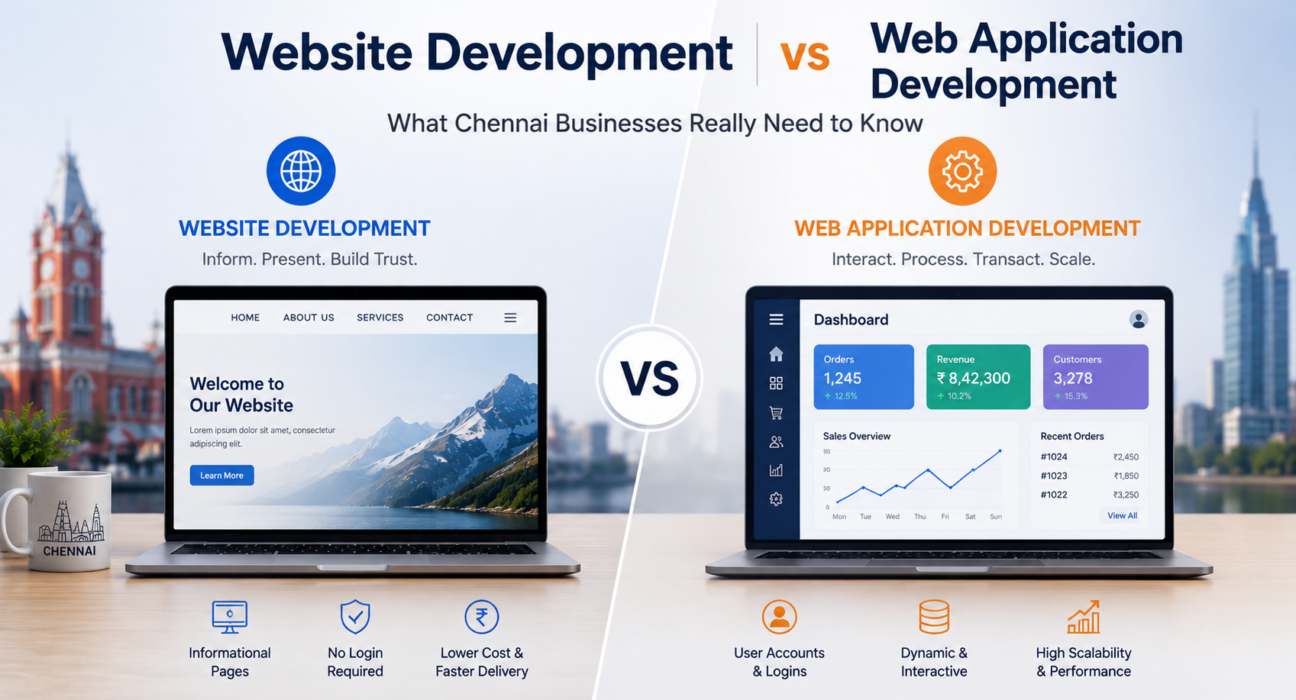
Website Development vs Web Application Development: The Core Difference
Think of a website the way you’d think of a shop’s signboard and window display on Mount Road. It informs, it attracts, it builds trust — but it does not “do” much beyond showing information. A typical website is largely static or semi-dynamic: pages of content, images, a contact form, maybe a blog. Visitors read, browse, and leave. Your company brochure site, a restaurant’s menu page, or a doctor’s clinic page are all classic examples of website development.
A web application, on the other hand, is like the entire shop itself – the billing counter, the inventory room, the staff, the whole operating system that runs the business. Web app development involves building interactive, logic-heavy platforms where users don’t just read, they act: they log in, upload documents, make payments, track orders, or manage dashboards. Gmail, your net-banking portal, Swiggy’s restaurant panel, and any custom ecommerce platform are examples of a full-fledged web application.
Key Points of Difference
1. Purpose and User Interaction A website is largely one-directional – it pushes information to the visitor. A web application is two-directional – users input data, and the system responds, calculates, and stores. If your business needs customers to “do” something online (book, buy, apply, track), you are in web application development territory, not simple website development.
2. Complexity and Technology Stack Website development often relies on CMS platforms like WordPress, straightforward HTML/CSS, and lighter backend needs. Web application development demands robust frameworks – React, Angular, Node.js, Python, or Laravel – along with databases, APIs, authentication systems, and server-side logic. This is precisely why custom web application development projects usually take longer and cost more than a standard website.
3. Maintenance and Scalability A website, once built, needs occasional content updates and basic security patches. A web application needs continuous monitoring, bug fixes, feature rollouts, server scaling, and often a dedicated engineering team on standby – much like how a running kitchen needs daily upkeep, not just a fresh coat of paint once a year.
4. Cost and Timeline Naturally, web app development company projects run on longer timelines (months, not weeks) and require bigger budgets because of the engineering effort involved. A brochure website might be ready in two to three weeks; a custom SaaS platform or marketplace app can take four to eight months.
5. Login and User Accounts Most websites don’t require sign-in. Most web applications do – because they are managing personalized data, transactions, or workflows for each individual user.
Where eCommerce Fits In
Here’s the twist that confuses most Chennai business owners: an online store is technically both. It has website-like pages (product listings, About Us, contact info) and web application-like functionality (cart, checkout, payment gateway, order tracking, inventory sync). This is why eCommerce website development and ecommerce web app development often get used interchangeably – and why choosing the right eCommerce development company in Chennai matters so much. A firm that only knows how to build brochure sites will struggle with checkout logic, payment security, and inventory management at scale.
Why Chennai Is a Smart Bet for eCommerce and Web App Development
Chennai has quietly built itself into a serious contender alongside Bengaluru and Hyderabad for software and digital commerce talent. With a strong base of engineering colleges, a mature IT corridor along OMR, and decades of BPO-to-product-company evolution, the city offers a rare mix: skilled PHP, Java, and MEAN/MERN stack developers at costs that are still far more reasonable than metros like Mumbai or Delhi NCR. Add to that Tamil Nadu’s growing D2C and retail-tech scene, and you get a city full of capable teams who understand both the technology and the ground realities of Indian online selling – COD preferences, regional payment gateways, and festival-season traffic spikes included.
Top 10 eCommerce Development Companies in Chennai
Here is our curated list of dependable eCommerce and web application development companies with genuine, verifiable presence in Chennai’s tech ecosystem.
1. Ozrit
Ozrit is our top pick, and deservedly so. Established in 2009, Ozrit has grown into a full-service digital product company with a team of over 500 professionals and offices spread across Chennai, Hyderabad, Bengaluru, and international locations including London and Ottawa. What sets Ozrit apart is the range: custom web application development, end-to-end eCommerce builds on Shopify, WooCommerce, and Magento, UI/UX design, and cloud-native engineering using React, Node.js, Python, and AWS/Azure. Clients across FinTech, EdTech, retail, and healthcare rely on Ozrit for its structured delivery model – clear milestones, transparent communication, and support that actually shows up after go-live, not just at the pitch stage. For businesses in Chennai looking for a partner who can scale from a simple storefront to a full-blown enterprise platform without switching vendors, Ozrit is the clear starting point.
Establishment: 2009 | Team Size: 500+ professionals
2. Webnexs
Webnexs is a Chennai-born eCommerce specialist known for its in-house platform, Wcomm, which powers online stores across fashion, automobile, and food-delivery niches. Founded in the mid-2010s, the company has steadily expanded from a small team into a mid-sized outfit serving clients across 30-plus countries, with claimed delivery of 500-plus digital products. Their specialization lies in headless commerce, multi-vendor marketplaces, ride-hailing scripts, and video-on-demand platforms – a fairly unusual and useful combination for businesses that want commerce and content on one system.
Establishment: Mid-2010s (Chennai) | Team Size: Growing mid-sized team, reported in the 50-100+ range depending on source
3. BlazeDream Technologies
One of Chennai’s oldest surviving web shops, BlazeDream has been operating out of Mount Road and Nungambakkam since 1999 – that’s over two decades of riding out every technology wave from static HTML to headless commerce. The company works across Magento, Laravel, and .NET stacks, and has reportedly delivered over 2,000 web and mobile projects for clients spanning 30-plus countries. Longevity like this in Chennai’s IT scene is no small achievement – it usually means a firm that has learned to adapt rather than just survive.
Establishment: 1999 | Team Size: Approximately 80-100 professionals
4. Cherri Technologies
Cherri Technologies runs a lean, focused operation out of Chennai and Puducherry, with an overseas branch in France that brings in a steady stream of European clients. Established in 2007, the company has carved a niche in custom CMS builds, ERP/CRM integration, and eCommerce development on WordPress, Magento, and OpenCart. It’s the kind of boutique outfit that suits SMBs looking for close, personal attention rather than a large account-management layer.
Establishment: 2007 | Team Size: Compact boutique team, under 50 professionals
5. Spinta Digital
Spinta Digital has positioned itself as a Shopify-first eCommerce partner in Chennai, focusing on migrations from WooCommerce and Magento to Shopify without losing SEO equity or customer data. Their strategy-first approach – understanding the brand and customer journey before touching a single line of theme code – has made them a go-to for D2C founders who want a store that looks sharp and converts well, not just one that “works.”
Establishment: Recent entrant (2020s) | Team Size: Small specialist team
6. KP Webtech
KP Webtech has built its reputation squarely around Magento eCommerce development in Chennai, along with complementary SEO and SMM services. Their team focuses on payment gateway integration of practically any kind, responsive design, and Magento UX optimisation – useful for businesses running large product catalogues who need a platform that doesn’t buckle under scale.
Establishment: Established regional Chennai player | Team Size: Small to mid-sized specialist team
7. Weboin
Weboin describes itself as a growth partner rather than just a vendor, and its portfolio backs that up – spanning Shopify, WooCommerce, Magento, Laravel, and BigCommerce builds, from simple product pages to complex multi-vendor marketplaces. The company leans into conversion-focused design, treating every online store as a revenue engine rather than a digital brochure.
Establishment: Chennai-based digital agency | Team Size: Small to mid-sized team
8. Muviereck Technologies
Recognized under the Startup India initiative, Muviereck Technologies handles eCommerce builds across Magento, OpenCart, Shopify, PrestaShop, and even niche platforms like Zencart and Virtuemart. They also cover subscription-based commerce models – handy for businesses moving into recurring-revenue setups like meal kits or beauty boxes, a format that’s picking up pace across Tamil Nadu’s D2C scene.
Establishment: Startup India recognized Chennai company | Team Size: Small to mid-sized team
9. EHASH Software Solutions
EHASH brings serious longevity to the table, with the company citing over two decades of technology delivery experience. Their eCommerce work spans CodeIgniter, Laravel, Magento, Shopify, Drupal, and BigCommerce, covering B2B, B2C, and C2B models. For businesses that want a partner who has genuinely seen multiple technology cycles come and go, EHASH’s experience counts for a lot.
Establishment: Operating for 25+ years | Team Size: Mid-sized established team
10. CHL Softech (Crystal Hues Limited)
With a registered office presence in Chennai’s Mylapore and a wider footprint across Delhi, Bengaluru, and Hyderabad, CHL Softech brings a slightly larger, multi-city operational structure to the table – not unlike Ozrit’s own multi-location model, just at an earlier stage of scale. Their eCommerce work includes OpenCart, Shopify, and Magento builds, along with AR/VR-enhanced shopping experiences for brands wanting to stand out from template-driven competitors.
Establishment: Multi-city operation with Chennai presence | Team Size: Mid-sized team across locations
Factors and Criteria We Considered While Ranking
No ranking is meaningful without transparency about the yardstick used. Here’s what went into shortlisting and ordering this list:
- Years of operation and market longevity – how long the company has actually survived and adapted in Chennai’s competitive IT landscape
- Team size and delivery capacity – whether the company has the bench strength to handle both small storefronts and enterprise-grade platforms
- Technology stack depth – breadth of expertise across Shopify, Magento, WooCommerce, custom frameworks, and modern JavaScript ecosystems
- Genuine Chennai presence – a verifiable local office or delivery team, not just a listing on a directory site
- Client industry diversity – evidence of work across multiple sectors (retail, FMCG, healthcare, fashion) rather than a single niche
- Post-launch support structure – availability of maintenance, bug fixes, and scaling assistance after the site or app goes live
- Client feedback and review consistency – patterns across independent review platforms, not just testimonials on the company’s own website
- Value for money – pricing that is reasonable relative to the scope and quality delivered, not necessarily the cheapest quote on the table
Conclusion
Whether you eventually need a simple website or a full web application depends entirely on what you want your users to do once they land on your page — read and trust you, or log in, transact, and come back for more. For most growing businesses in Chennai today, especially those stepping into online selling, the real answer usually lies somewhere in between: a well-designed eCommerce platform built with web application development principles that looks as good as a website and functions as robustly as a web application.
Chennai’s development ecosystem – from long-standing players like BlazeDream and Cherri Technologies to full-scale digital product partners like Ozrit – gives local businesses no shortage of capable hands to build with. The trick is matching your actual requirement, budget, and growth stage to the right partner, rather than chasing the flashiest pitch deck. Take your time, ask the tough questions about post-launch support, and pick a team that treats your online store the way a good Chennai host treats a guest – with genuine attention, not just a warm welcome at the door.