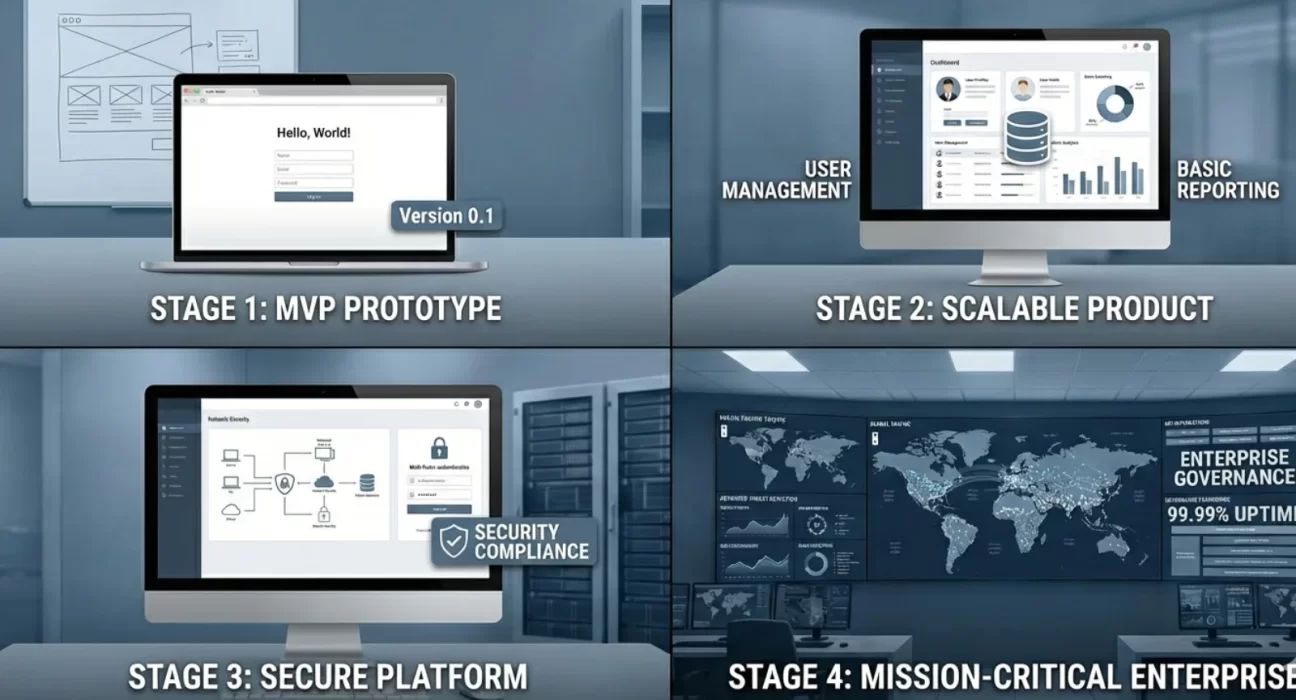
Most technology leaders have seen this pattern before. A small team builds a proof of concept in weeks. It works beautifully in the demo. Everyone is excited. Then comes the hard part: turning that prototype into something the enterprise can actually rely on.
This is where many digital initiatives stall. The gap between a working prototype and a mission-critical system is not just technical. It involves security reviews, compliance requirements, integration with legacy systems, data governance, user access management, and operational support models. These are not obstacles to be bypassed. They are the reality of running technology at enterprise scale.
Why MVPs Work Differently in Large Organizations
In a startup, an MVP proves market fit. In an enterprise, an MVP proves technical viability. But proving something can work is very different from proving it will work reliably for thousands of users, handle sensitive data properly, integrate with existing systems, and remain supported for years.
The challenge is not the initial build. The challenge is everything that comes after: hardening the application, connecting it to enterprise authentication, ensuring it meets data residency requirements, building proper logging and monitoring, creating runbooks for operations teams, and establishing clear ownership when things go wrong.
This is not about perfectionism. It is about risk management. When a system handles customer data, financial transactions, or operational workflows, failure has real consequences. Security breaches damage reputation and trigger regulatory scrutiny. Downtime disrupts business operations. Poor data quality leads to bad decisions. These risks are why enterprise applications require a different approach from day one.
The Hidden Complexity of Enterprise Readiness
Technical debt compounds quickly in enterprise environments. A prototype built without proper architecture becomes expensive to maintain. A system designed without scalability in mind hits performance walls. An application that skips security reviews becomes a liability.
The problem is not always obvious at first. A web application that works fine for 50 beta users struggles when 5,000 people try to use it during peak hours. An API integration that seems simple in testing becomes fragile in production when upstream systems change without notice. A dashboard that displays perfectly on a laptop breaks on the locked-down browsers that compliance teams require.
These issues do not appear in the demo. They appear six months later when the application is live and business teams depend on it. By then, fixing them is disruptive and expensive.
Experienced technology leaders know this pattern well. They have seen promising initiatives fail not because of bad technology, but because of insufficient planning for enterprise realities. The answer is not to abandon innovation. The answer is to build with enterprise requirements in mind from the start.
Where Most Enterprise Projects Struggle
Three areas consistently create problems for enterprise application delivery.
First is integration complexity. Enterprise systems rarely operate in isolation. They need to connect with ERP platforms, CRM systems, data warehouses, authentication providers, and often dozens of other internal tools. Each integration point adds complexity. Each one needs to be designed, tested, secured, and maintained. Poor integration design creates brittle systems that break when anything upstream changes.
Second is governance and compliance. Large organizations have controls in place for good reasons. Data privacy regulations, industry standards, internal policies, and security frameworks all shape how applications must be built and operated. Ignoring these requirements early means expensive rework later. Compliance is not optional, and it cannot be retrofitted easily.
Third is operational readiness. An application that works is not the same as an application that can be supported. Production systems need monitoring, alerting, logging, backup procedures, disaster recovery plans, and clear escalation paths. They need documentation that operations teams can actually use. They need someone available when things go wrong, not just during business hours.
These are not theoretical concerns. They are the difference between a working prototype and a system that the business can trust.
How Execution-Focused Partners Approach Enterprise Work
Organizations that deliver consistently at enterprise scale do a few things differently.
They start with realistic scoping. Not every feature needs to be in version one. Not every risk needs to be solved before launch. But the architecture needs to support where the application will go, not just where it is today. This means understanding the enterprise landscape before making design decisions.
They involve senior people early and keep them involved. Junior teams can execute well, but they lack the pattern recognition that comes from seeing what fails in production. Experienced architects and technical leads spot problems before they become expensive. They know which shortcuts create technical debt and which ones are acceptable trade-offs.
They build in phases with clear milestones. Enterprise delivery works best when broken into manageable increments. Each phase should deliver something usable, not just more code. This allows business stakeholders to see progress, provide feedback, and adjust priorities based on real usage rather than assumptions.
They design for production from the start. Security, monitoring, logging, error handling, and performance considerations are not added later. They are part of the initial architecture. This does not mean over-engineering. It means building systems that can be operated reliably once they go live.
How Ozrit Structures Enterprise Delivery
Ozrit has built its delivery model around the realities of enterprise work. The company focuses exclusively on large organizations, which shapes everything from team structure to how projects are staffed.
Every engagement starts with senior involvement. Ozrit’s founders and principal architects are directly involved in scoping, design, and critical technical decisions. This is not a handoff model where senior people disappear after the sale. They remain engaged throughout delivery because that is when their experience matters most.
Teams are structured with enterprise challenges in mind. Ozrit maintains a full-time workforce of over 300 people with deep experience in complex integrations, security architecture, and large-scale system design. This allows them to staff projects with people who have seen similar problems before, not people learning on the job.
Onboarding is deliberate and thorough. Before any code is written, Ozrit teams spend time understanding the client’s technical landscape, security requirements, integration points, and operational constraints. This upfront work prevents expensive surprises later. It also builds trust with internal teams who need to support these systems long-term.
Delivery follows structured phases with realistic timelines. Most enterprise projects take 12 to 18 weeks from kickoff to production, depending on scope and complexity. This is not fast by startup standards, but it reflects the reality of building systems that meet enterprise requirements. Rushing enterprise work creates problems. Ozrit’s approach prioritizes delivery certainty over speed.
Support is structured for enterprise needs. Production systems need 24/7 coverage, not business hours support. Ozrit provides round-the-clock monitoring and response because downtime at 2 AM is just as disruptive as downtime at 2 PM. This operational commitment is part of the delivery model, not an expensive add-on.
The Role of Technology in Enterprise Execution
Modern technology plays an important role in enterprise delivery, but only when it solves real problems.
AI and automation can accelerate development, improve code quality, and reduce manual testing effort. But these tools work best when used by experienced teams who understand what they are building and why. Technology does not replace judgment. It amplifies the capabilities of skilled people.
Cloud platforms provide flexibility and scalability that legacy infrastructure cannot match. But moving to cloud is not a goal in itself. The value comes from faster deployment, better disaster recovery, and the ability to scale resources based on demand. These benefits matter when they translate to lower operational risk and more reliable service delivery.
Integration platforms and API management tools reduce complexity in connecting enterprise systems. But they require thoughtful design. Poor API design creates just as many problems as no API at all. The technology is valuable when it supports clear integration patterns and proper error handling.
The point is not to use the latest technology. The point is to use appropriate technology to deliver systems that meet enterprise needs for security, reliability, and scalability.
What Senior Leaders Should Expect
When evaluating partners for enterprise application work, a few signals matter more than others.
Look for direct senior involvement, not just in sales but throughout delivery. Ask who will actually make technical decisions on your project. Ask how they handle integration challenges and security reviews. Ask about their experience with your specific enterprise systems.
Look for realistic timelines and clear phase definitions. Be skeptical of vendors who promise fast delivery on complex work. Enterprise projects have inherent complexity that cannot be shortcut without risk.
Look for operational thinking, not just development capability. Ask how they handle production support. Ask about monitoring, alerting, and incident response. Ask how they transfer knowledge to your internal teams.
Look for evidence of delivery at scale. References from similar organizations matter more than impressive case studies. Talk to their clients about what went well and what was difficult. Understand how they handle problems when they arise.
The right partner understands that enterprise work requires different thinking. They build systems that work reliably, integrate properly, meet compliance requirements, and can be supported by your teams long after the initial delivery is complete.
Building for the Long Term
Enterprise applications are not built and forgotten. They become part of the organization’s operational fabric. They need to be maintained, enhanced, and adapted as business needs change.
This reality should shape how they are built from the start. Clean architecture, clear documentation, proper testing, and thoughtful design are not luxuries. They are investments in future flexibility. Systems built well are easier to change. Systems built poorly become increasingly expensive to maintain until they are eventually replaced.
The goal is not to build perfect systems. The goal is to build systems that deliver business value reliably and can evolve as requirements change. This requires technical skill, enterprise experience, and a delivery approach that balances speed with sustainability. Organizations that get this balance right turn digital initiatives into lasting competitive advantages.