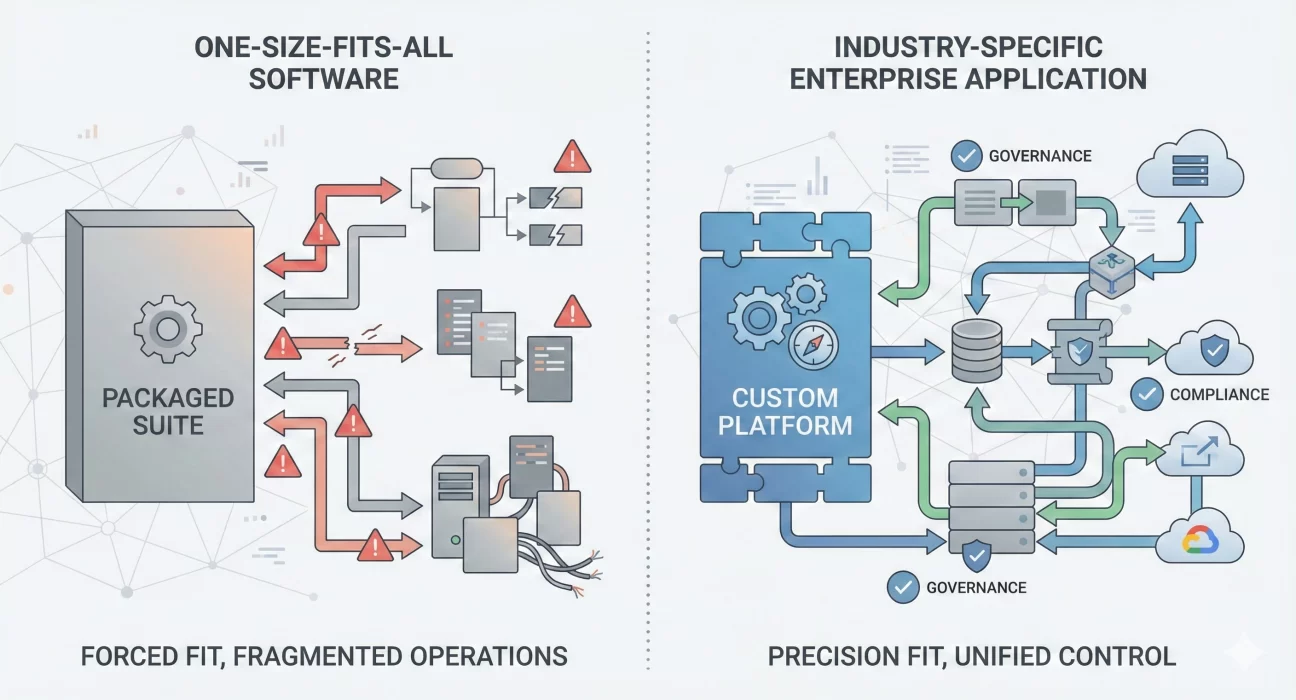
Every large enterprise reaches a point where standard software becomes a constraint rather than an enabler. The procurement team pushes for standardisation. The implementation partner promises flexibility. Six months later, you’re sitting in a steering committee meeting wondering why the system that worked perfectly at three other companies is failing at yours.
The answer is usually straightforward. Your business isn’t like those other companies. Your supply chain has different handoff points. Your compliance requirements respond to different regulators. Your customer data flows through legacy systems that were built when your competitors didn’t exist yet. The software that worked elsewhere assumes a business model you don’t have and workflows you’ve never followed.
The Cost of Configuration Theatre
Most packaged enterprise applications arrive with promises of configurability. The vendor demonstrates how you can adjust workflows, customise dashboards, and modify approval chains. What they don’t show you is what happens when your actual requirements conflict with the application’s fundamental assumptions.
You end up in what experienced CIOs call configuration theatre. Your team spends months tweaking settings, building workarounds, and documenting exceptions. The application technically does what you need, but only if users follow a sequence of steps that makes no operational sense. Training becomes complicated. Adoption drops. Shadow systems emerge because people need to get work done.
The real damage shows up in your cost structure. You’re paying enterprise licensing fees for software that your teams are working around. You’re maintaining integrations that wouldn’t be necessary if the core application actually fit your processes. Your internal technology team spends more time managing vendor relationships and configuration requests than building capabilities that differentiate your business.
When Industry Solutions Miss the Industry
Vendors have responded to this problem by creating industry-specific versions of their platforms. Financial services gets one configuration. Healthcare gets another. Manufacturing gets a third. The theory makes sense until you examine what industry-specific actually means.
These industry solutions optimise for the common denominator. They include features that most banks need or workflows that most hospitals follow. If your institution operates like most others in your sector, you might be fine. But large enterprises rarely succeed by operating like everyone else.
Your competitive advantage often lives in the differences. The way you underwrite risk. How you manage clinical trials. Your approach to inventory optimisation. These aren’t just process variations. They’re the accumulated knowledge of decades of operation in your specific market position. An industry solution that ignores these differences isn’t saving you money. It’s asking you to abandon what makes you competitive.
The integration challenge compounds the problem. Your enterprise runs on systems that were built over twenty or thirty years. Some of those systems are genuinely outdated and should be replaced. Others contain business logic that would take years to recreate and validate. An industry-specific application that can’t integrate with your existing environment creates more problems than it solves.
The Hidden Multiplier Effect
Enterprise applications don’t exist in isolation. They connect to other systems. They feed data to analytics platforms. They trigger workflows in adjacent applications. When your core application doesn’t quite fit, every downstream system inherits that misalignment.
Your reporting becomes complicated because the data structure doesn’t match how your business thinks about performance. Your automation breaks because the application’s API wasn’t designed for your integration patterns. Your business intelligence team builds translation layers and mapping tables to make sense of information that should have been structured correctly from the start.
This multiplier effect is why large enterprises often discover that the total cost of a standard application far exceeds the initial licensing and implementation estimate. You’re not just paying for the core system. You’re paying for all the compensating mechanisms needed to make it work in your environment.
What Custom Development Actually Means at Scale
The alternative to forcing standard software into your environment is building applications that fit your requirements from the beginning. This immediately raises concerns about cost, timeline, and risk. Those concerns are valid if you approach custom development the way it was done twenty years ago.
Modern enterprise custom development isn’t about starting from scratch. It’s about understanding which parts of your application need to be truly custom and which parts can leverage proven components and frameworks. Your authentication doesn’t need to be custom. Your user interface patterns probably don’t either. But your core business logic, your data model, and your integration architecture often do.
The quality bar for enterprise custom applications is significantly higher than it was a decade ago. Your users now expect the same experience they get from consumer applications. Your security team expects modern architecture patterns. Your operations team expects reliability that matches or exceeds commercial software. Meeting these expectations requires different capabilities than building departmental applications or proof-of-concept systems.
How Ozrit Approaches Enterprise Application Development
Ozrit works with large enterprises that have decided standard software won’t meet their needs. Our approach starts with understanding why you’re considering custom development instead of configured solutions. Often, the decision comes down to integration complexity, regulatory requirements that don’t fit standard models, or business processes that create genuine competitive advantage.
We structure enterprise application programs around delivery certainty rather than theoretical flexibility. You get a dedicated senior team from day one. Not a sales team that hands you to delivery resources later. The people who scope your program are the people who build it. This eliminates the translation problems that plague large implementations.
Our teams typically include fifteen to twenty people for substantial enterprise applications. That’s large enough to make real progress but small enough to maintain clear communication and accountability. You’re not managing a cast of fifty where no one knows who owns what. You’re working with a focused group where roles and responsibilities are explicit.
The onboarding process takes this seriously. Before any development work begins, we spend two to three weeks understanding your technical environment, your integration requirements, and your operational constraints. This isn’t requirements gathering in the traditional sense. It’s building a realistic picture of what delivery will actually involve. If we identify risks or dependencies during onboarding, you know about them before commitments are made.
Development follows a structured timeline that accounts for enterprise realities. A substantial application typically takes twelve to eighteen months from kickoff to production. That includes time for security reviews, integration testing, user acceptance validation, and the operational readiness work that large enterprises require. We don’t promise six-month miracles. We deliver working systems that your organisation can actually deploy and support.
After go-live, you’re not on your own. Our support model includes 24/7 availability for production issues and ongoing access to the team that built your application. When something needs to change, either because requirements evolved or because you discovered a better approach, the people who understand your system are available to make it happen.
Technology Choices That Reduce Risk
Enterprise custom applications need to be supportable for years, not months. That influences every technology decision. We favour established frameworks and proven architecture patterns over experimental approaches. Your application should be maintainable by competent engineers, not just the specific team that built it.
AI and automation get incorporated where they create measurable value. Document processing that used to require manual review. Data validation that catches errors before they propagate through your systems. Monitoring that identifies performance problems before users notice them. These aren’t AI features for the sake of having AI. They’re capabilities that make your application more reliable and less expensive to operate.
The architecture decisions matter more than the specific technology choices. Your application needs to integrate with systems you’re running today and systems you’ll adopt five years from now. It needs to scale as your business grows. It needs to support the security and compliance requirements your auditors will ask about. Getting architecture right early eliminates the painful rebuilds that happen when applications hit their design limits.
When Custom Development Is the Lower Risk Option
Large enterprises often perceive custom development as riskier than implementing commercial software. That calculation changes when you account for the full cost of making standard software work in a non-standard environment. The configuration effort. The integration complexity. The organisational change management needed to force your business into the application’s model.
Custom development becomes lower risk when you’re certain about your requirements and realistic about your timeline. If you know how your business operates and you understand that building the right solution takes real time, custom development gives you more control over the outcome. You’re not hoping the vendor’s roadmap eventually addresses your needs. You’re building exactly what your business requires.
The ongoing advantage is often underestimated. When your application fits your business model, changes are straightforward. You’re not negotiating with a vendor about whether your requested feature aligns with their product strategy. You’re making direct decisions about your own system. That agility has compounding value as your business evolves.
Making the Decision With Open Eyes
Not every enterprise application should be custom built. If standard software genuinely meets your needs and integrates cleanly with your environment, that’s probably the right answer. The decision to build custom becomes clear when you’re facing significant compromise on core requirements or when the total cost of adaptation exceeds the cost of building correctly.
What matters most is making the decision based on realistic assessment rather than assumptions about risk. Custom development at enterprise scale is neither automatically better nor automatically worse than commercial software. It’s a different set of trade-offs that makes sense for certain situations and certain organisations. Understanding which situation you’re actually in prevents expensive mistakes in either direction.