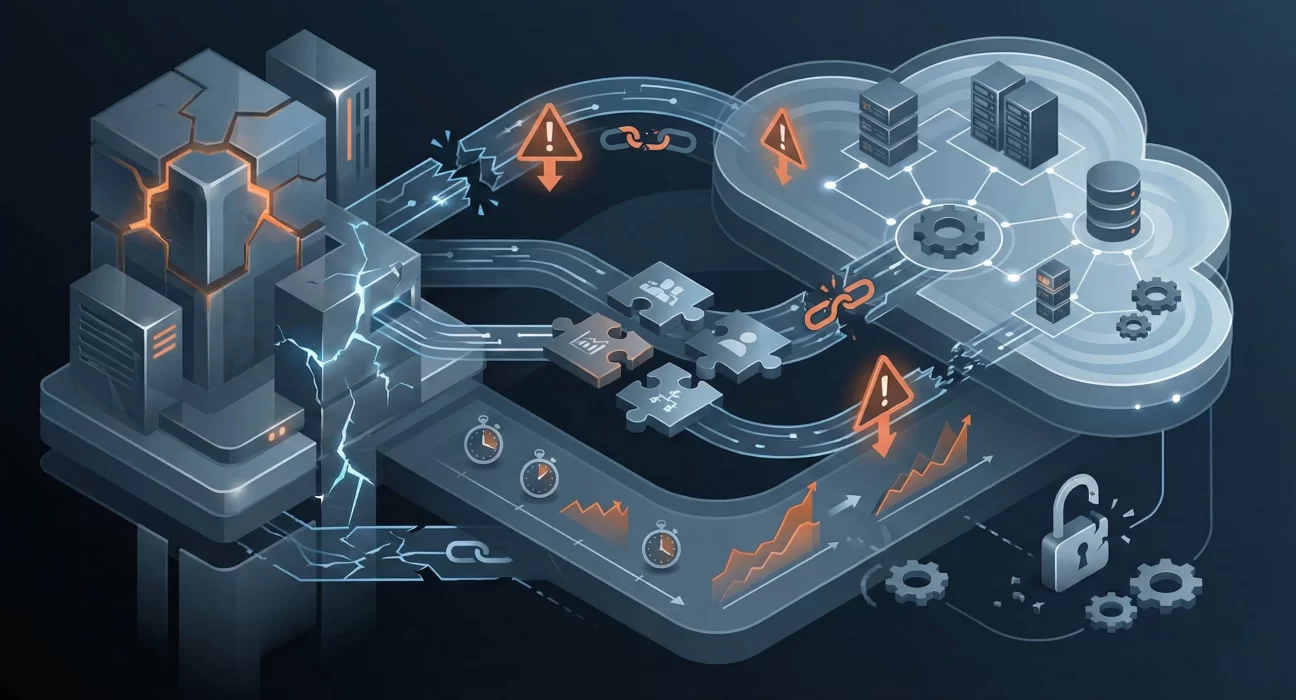
Every year, Indian and global enterprises invest billions in cloud transformation initiatives. Yet research consistently shows that 60-70% of these programs either fail to meet their objectives or deliver significantly below expectations.
This isn’t about technology anymore. Cloud platforms are mature, stable, and proven. The failures happen elsewhere in how programs are structured, governed, and executed. After working across dozens of large-scale enterprise transformations, we’ve seen the same patterns repeat themselves. The good news is that most of these pitfalls are avoidable.
This article examines what actually goes wrong in enterprise cloud transformation programs and what it takes to get them right.
The Scale Problem That Nobody Talks About
Small-scale cloud migrations are relatively straightforward. You lift and shift a few applications, modernise where it makes sense, and you’re done. Enterprise transformations are fundamentally different.
When you’re moving 200+ applications, managing 15+ business units, coordinating across geographies, and maintaining zero disruption to operations, complexity multiplies exponentially. What works for a startup or a single department falls apart at enterprise scale.
The first major pitfall is treating enterprise transformation like an enlarged version of a small project. It’s not. The governance structures, decision-making frameworks, risk management protocols, and stakeholder alignment mechanisms need to be designed for scale from day one.
Many programs start without this foundation. They assume they’ll “figure it out as they go” or that existing IT governance will suffice. Three months in, when you have 12 workstreams, 200+ stakeholders, multiple vendors, and conflicting priorities, the lack of structure becomes paralysing.
The Timeline Trap
Here’s a conversation that happens in almost every enterprise program kickoff:
Business: “When will this be done?”
IT/Vendor: “Eighteen months for full migration.”
Business: “We need it in nine months. The board wants results.”
IT/Vendor: “We’ll try our best.”
This is where programs start failing before a single server is migrated. Enterprise cloud transformation timelines are determined by real constraints, application dependencies, data migration volumes, testing cycles, compliance requirements, change management needs, and business continuity obligations. These constraints don’t disappear because someone wants faster results.
Unrealistic timelines lead to rushed decisions, inadequate testing, poor documentation, incomplete security reviews, and burned-out teams. When things inevitably slip, trust erodes between business and IT leadership. The program gets labelled as “behind schedule” even if the original schedule was never achievable.
Successful programs start with honest, evidence-based timeline planning. They build in buffers for the unexpected (which always happens). They define clear milestones that balance speed with quality. And they have executive sponsors who defend realistic timelines against pressure for arbitrary deadlines.
Governance Without Teeth
Most enterprise programs have governance structures on paper. Steering committees, working groups, change control boards, risk committees. The meetings happen. The PowerPoints get created. But decisions don’t get made, or worse, decisions get made and then ignored.
Governance without enforcement is theatre. It creates the illusion of control while problems accumulate beneath the surface.
Real governance means:
Someone has final decision-making authority and uses it. Escalations get resolved within defined timeframes, not left hanging. When conflicts arise between business units, there’s a clear mechanism to resolve them. When vendors miss commitments, there are consequences. When scope creeps (and it will), there’s a disciplined process to evaluate, approve, or reject changes.
The enterprises that succeed in cloud transformation have governance that’s simple, clear, and actually followed. Weekly decision forums with defined agendas and action tracking. Clear RACI matrices that everyone understands. Escalation paths that work in days, not weeks.
One pattern we’ve seen work well at companies like Ozrit when supporting enterprise clients: a small, empowered program management office that reports directly to the CIO or CTO, with authority to cut through bureaucracy and drive decisions. Not a large team of five to seven experienced people who know how to manage complexity and hold stakeholders accountable.
The Vendor Management Blindspot
Enterprise cloud transformations typically involve multiple vendors. Your hyperscaler (AWS, Azure, GCP), perhaps a systems integrator, several specialised vendors for security, networking, monitoring, and migration tools, plus your existing managed services providers.
The assumption is that each vendor will manage their part and everything will come together seamlessly. It rarely does.
Vendors optimize for their own scope, their own contracts, and their own success metrics. Unless someone is actively orchestrating across all vendors, gaps appear. Each vendor assumes someone else is handling the integration points. Critical dependencies get missed. When problems occur, everyone points at everyone else.
The enterprises that manage this well treat vendor orchestration as a core competency, not an afterthought. They assign clear ownership usually to the PMO or a dedicated vendor management function. They create integrated program plans that show dependencies across all vendor workstreams. They run regular cross-vendor sync meetings where issues get surfaced and resolved.
They also know when to bring in partners who understand enterprise delivery complexity. Working with execution-focused partners who’ve been through this before can dramatically reduce the coordination overhead and risk.
The Legacy System Reality
Every enterprise has them. The 15-year-old ERP system that’s been customised beyond recognition. The mainframe application that processes millions of transactions daily and nobody fully understands anymore. The homegrown CRM that three generations of developers have modified.
Cloud transformation programs often underestimate what it takes to migrate or modernise these systems. The initial assessment says “six months to re-platform.” Twelve months later, you’re still discovering dependencies, data quality issues, and undocumented business logic.
Legacy systems are complex not just technically, but organisationally. They have stakeholders who’ve built their workflows around system quirks. They have undocumented interfaces to other systems. They contain business rules that exist nowhere except in the code. They process data in ways that made sense 10 years ago but don’t align with modern practices.
Successful programs approach legacy systems with appropriate respect and realism. They invest in proper discovery and dependency mapping before committing to timelines. They plan for unexpected complications. They involve business users early to document actual usage patterns, not just what the specifications say. They consider hybrid approaches; maybe some components move to cloud, while others stay on-premise for now.
Cost Overruns and the Business Case Illusion
The business case that got your cloud transformation approved probably showed significant cost savings. Lower infrastructure costs, reduced data centre footprint, operational efficiency gains. Maybe you’re projecting 30-40% reduction in IT spend.
Two years into the program, you’ve spent more than planned, and costs haven’t decreased yet. In fact, they might have increased as you’re running dual environments during migration.
This pattern is incredibly common and creates serious credibility problems for IT leadership. The CFO wants to know why the promised savings haven’t materialised. The board questions whether the program should continue.
Here’s what usually gets missed in the original business case:
The full cost of migration work assessment, planning, testing, validation, and remediation. The cost of running parallel environments during transition. The cost of new skills and certifications the team needs. The cost of organisational change management and training. The cost of security and compliance upgrades that become necessary. The cost of architectural improvements that should have been done anyway.
Cloud can absolutely deliver cost benefits, but they typically come after the transformation is complete, not during it. Realistic business cases acknowledge upfront investment and set proper expectations about when benefits will materialise.
Better yet, they focus on business value beyond cost reduction faster time to market, improved scalability, better disaster recovery, enhanced security, ability to adopt new technologies. These are often more compelling reasons for cloud transformation than cost savings alone.
The Compliance and Security Gap
In the rush to move to the cloud, security and compliance often become bottlenecks. The security team wasn’t involved early enough. The compliance requirements for your industry weren’t fully mapped. The data residency rules in India and other countries you operate in weren’t properly understood.
Now you’re six months into migration and discover that your planned architecture doesn’t meet regulatory requirements. Or that your security controls aren’t sufficient for production workloads. Everything stops while you redesign.
Enterprises that handle this well bring security and compliance into the planning process from day one. Not just for review, but as active participants in architecture decisions. They map out all applicable regulations, RBI guidelines for financial services, DPDP Act requirements, industry-specific compliance needs before finalising the cloud strategy.
They also recognise that cloud security is different from on-premise security. New skills are required. New tools are needed. The security operating model must evolve. This takes time and investment.
Ownership and Accountability Confusion
In traditional IT, roles were clear. The infrastructure team managed servers. Database team managed databases. The application team managed applications. In cloud transformations, these boundaries blur.
Who’s responsible for cloud cost optimization? Who owns security configurations? Who manages DevOps pipelines? Who handles incident response for cloud-native applications?
Without clear ownership, critical tasks fall through the cracks. Everyone assumes someone else is handling it. Or multiple teams try to manage the same thing in different ways, creating conflicts and inefficiency.
This is fundamentally an organisational design challenge, not a technical one. Successful enterprises redesign their operating models for cloud. They create new roles cloud architects, FinOps specialists, DevSecOps engineers. They clarify accountability through updated RACI matrices and service catalogues. They train existing staff and hire new capabilities where needed.
They also recognise that this organisational transformation is often harder than the technical migration. People are used to existing roles and responsibilities. Change creates uncertainty and resistance. Managing this requires active leadership involvement, not just HR policy updates.
The Change Management Afterthought
IT teams focus on migrating systems. They assume that once applications are running in the cloud, the job is done. Then they discover that users don’t know how to access the new systems. Business processes haven’t been updated. People are still following old workflows because no one told them things have changed.
Change management in enterprise transformations isn’t about sending a few emails and running some training sessions. It’s about helping thousands of people across multiple locations understand how their daily work will change, preparing them for it, and supporting them through the transition.
This includes detailed communication plans, role-specific training programs, updated documentation and procedures, hands-on support during go-live, and feedback mechanisms to address issues quickly.
Programs that treat change management as a workstream equal to technical delivery have much higher success rates. They allocate proper budget and resources to it. They start early, not three weeks before go-live. They measure adoption and user satisfaction, not just technical metrics.
What Separates Success from Failure
After examining dozens of enterprise cloud transformations, certain patterns consistently differentiate successful programs from failed ones.
Executive sponsorship that’s active, not ceremonial. The sponsor attends key meetings, makes tough calls when needed, and removes organisational obstacles. They don’t just lend their name to the program.
A program management approach designed for enterprise complexity. Not just project management scaled up, but purpose-built governance, decision-making frameworks, and coordination mechanisms.
Realistic planning based on actual enterprise constraints. Not aspirational timelines that make PowerPoints look good but have no relationship to reality.
Integrated vendor management with clear orchestration. Someone actively ensuring all the pieces come together, not hoping they will.
Strong technical leadership that understands both old and new worlds. People who can bridge legacy systems and modern cloud architecture, who know where the bodies are buried.
Adequate investment in people and process transformation. Not just technology migration, but organisational change.
Continuous risk management with real mitigation plans. Not risk registers that get updated monthly and then ignored, but active risk identification and management.
The Partner Question
Many enterprises ask whether they should handle cloud transformation internally or work with external partners. The answer usually isn’t binary.
Your internal teams know your systems, your business, and your constraints better than anyone. They should absolutely lead the transformation. But they may not have done a cloud migration of this scale before. They’re also busy keeping current systems running.
The right partners bring specific value: experience from multiple enterprise transformations, patterns for what works and what doesn’t, execution discipline and program management maturity, specialised skills your team may not have, and capacity to accelerate delivery without burning out your staff.
The key is finding partners who understand enterprise delivery, not just technology. Vendors who’ve only worked with startups or digital-native companies often struggle with enterprise realities, complex legacy environments, rigorous governance requirements, risk-averse cultures, and the need to maintain business continuity throughout transformation.
Firms like Ozrit have built their practice specifically around enterprise delivery and program execution. They understand that successful transformation requires more than technical expertise; it requires maturity in managing complexity, stakeholder alignment, and organisational change.
Looking Forward
Enterprise cloud transformation isn’t getting simpler. As businesses become more digital, the scope of these programs expands. More systems, more data, more integrations, more stakeholders, more complexity.
But the fundamentals of successful delivery remain constant. Clear ownership, realistic planning, disciplined governance, proper investment, active leadership, and execution maturity.
The enterprises that succeed aren’t necessarily the ones with the most advanced technology strategies. They’re the ones that treat transformation as a serious program requiring serious program management, that build the organisational foundations for success, that invest in their people alongside their technology, and that maintain execution discipline even when it’s difficult.
If you’re leading or sponsoring a cloud transformation program, the single most important thing you can do is be honest about what it really takes. Not what you wish it would take, not what makes the business case look good, but what actually delivering a program of this complexity requires.
Everything else follows from that honesty.