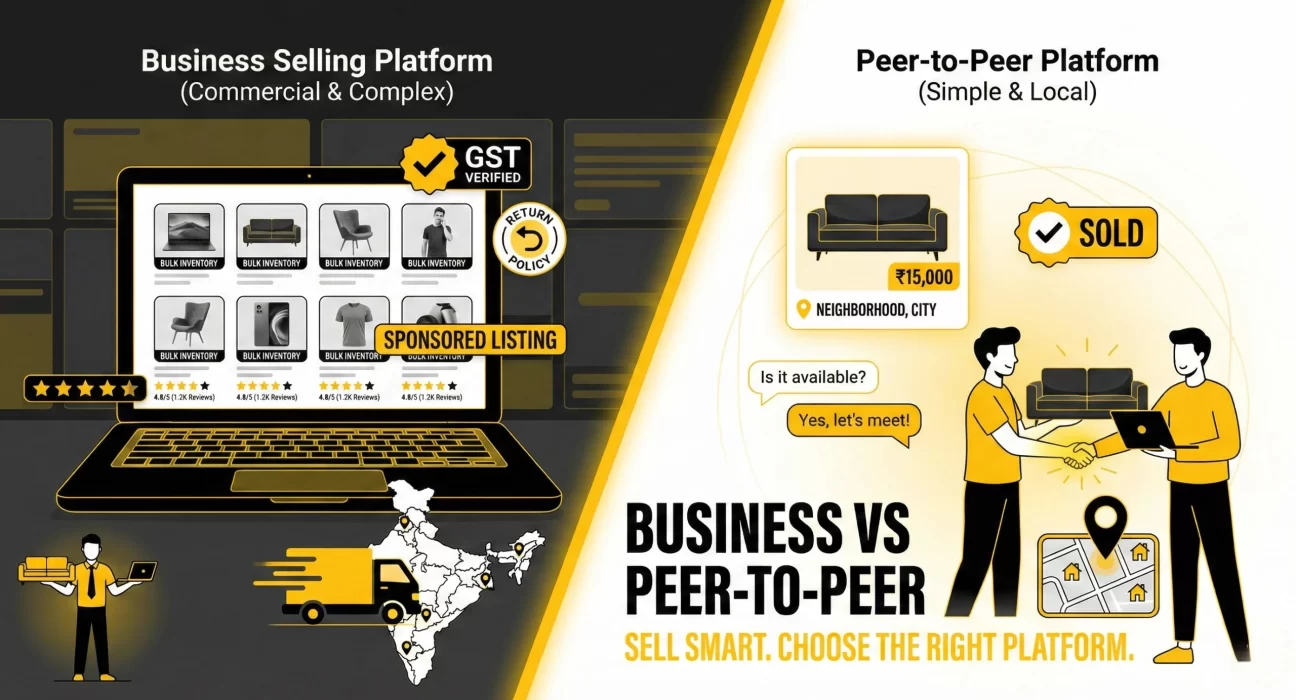
You’re selling your old sofa. You post it on a business-focused platform where it appears alongside hundreds of professional furniture dealers with studio photos, bulk inventory, and return policies. Your genuine, well-maintained sofa gets buried under their commercial listings.
Meanwhile, your friend posted similar furniture on a peer-to-peer platform where individuals sell to other individuals. A family from the same neighborhood saw it, came to check it out, and bought it within days.This difference matters more than most people realize. Business-oriented platforms are built for professional sellers with inventory, logistics, and commercial operations.
Peer-to-peer platforms and simple classifieds are built for everyday people selling used items to other everyday people. Understanding which type of platform matches your needs helps you buy and sell locally without wasting time competing against businesses or navigating systems designed for commerce you’re not doing.
What Makes Business Platforms Different
Business selling platforms are designed with commercial operations in mind.
- Professional seller infrastructure: Features for inventory management, bulk listings, pricing automation, business analytics.
- Return and refund policies: Structured systems for handling customer complaints, returns, and refunds like retail stores.
- Brand building tools: Seller ratings, store pages, follower systems, promotional features.
- Payment processing: Integrated gateways, invoicing, tax calculation, business account linking.
- Shipping and logistics: Partnerships with courier services, packaging guidelines, tracking systems.
- Customer service expectations: Professional communication standards, response time requirements, complaint resolution processes.
- Verification requirements: Business documentation, GST registration, identity verification, bank account validation.
This infrastructure serves businesses well but creates friction for individuals selling a few used items.
What Peer-to-Peer Platforms Prioritize
Peer-to-peer platforms take a fundamentally different approach.
- Individual selling focus: Built for people selling items they own, not inventory they’ve acquired for resale.
- Direct person-to-person connection: Buyer and seller communicate directly without platform intermediation or business protocols.
- Simple listing process: Photos, description, price, contact method—no business documentation or compliance requirements.
- Local transaction emphasis: Designed around face-to-face meetings and local pickup, not shipping and logistics.
- As-is sales assumption: Buyers inspect items before purchase, no return policies or warranty expectations.
- Minimal platform involvement: Connection happens through the platform, but the actual transaction is between individuals.
- No business operations needed: Sell one item or ten without registering as a business or managing commercial processes.
This simplicity matches how most used-item sales naturally work.
Why Competing with Businesses Is Frustrating
When individuals list on business-focused platforms, specific problems arise.
- Visibility disadvantage: Professional sellers pay for promoted listings, featured placements, and advertising. Your organic listing gets buried.
- Presentation gap: Businesses have professional photos, copywriters, and marketing. Your honest phone photos look amateur in comparison.
- Price pressure: Dealers buying wholesale and selling volume can undercut your prices while still making profit.
- Search algorithm bias: Platforms often favor sellers with high volumes, good ratings, and quick shipping,all business advantages.
- Expectation mismatch: Buyers on business platforms expect retail-like service, returns, warranties, things you’re not offering.
- Time disadvantage: Businesses respond instantly to enquiries with dedicated staff. You’re checking messages between work or studies.
You’re bringing a personal item to a commercial marketplace, and the system isn’t built for that.
Real Example: Selling a Laptop
A working professional in Hyderabad sold two identical laptops using different approaches.
Business Platform Experience:
- Listed on platform dominated by refurbished electronics dealers
- Spent time competing with professional listings showing 50+ similar laptops
- His listing appeared on page 4 of search results within hours
- Enquiries came from professional resellers trying to buy cheap for inventory
- Buyers expected warranties, return policies, shipping to other cities
- Price pressure from dealers selling refurbs at lower prices
- After two weeks: Sold at 25% below intended price to a reseller
- Felt like he’d competed poorly against businesses
Peer-to-Peer Platform (Best Classified Sites in Hyderabad):
- Listed on Sympl, focused on individual buyers and sellers
- Competed with other individuals selling personal items
- Listing stayed visible to local buyers
- Enquiries from people wanting laptops for personal use
- Met two serious buyers, both understood it’s a used item sold as-is
- Negotiated based on actual condition during in-person inspection
- After 6 days: Sold at fair price to student who needed it
- Felt like a straightforward person-to-person transaction
The peer-to-peer approach delivered better results and a more satisfying experience.
When Business Platforms Make Sense
Business-focused platforms serve legitimate purposes for certain users.
- You’re actually running a business: If you’re buying items to resell, refurbishing products, or operating a small enterprise, business platforms provide necessary tools.
- Selling new products: If you’ve manufactured, created, or are retailing new items, business infrastructure helps.
- Volume selling: If you have multiple similar items or regularly sell many things, business features like bulk listing make sense.
- Building a seller brand: If you want repeat customers, ratings, and reputation as a seller, business platforms support that.
- Willing to invest: If you’re ready to pay for promoted listings, shipping infrastructure, and platform fees as business expenses, the features justify costs.
- Professional presentation matters: If competing on polish and presentation is part of your strategy, business platforms are designed for it.
For these scenarios actual business operations business platforms are appropriate.
When Peer-to-Peer Platforms Work Better
Most individual selling situations favor peer-to-peer platforms.
- Selling used personal items: Your old furniture, bike you’ve outgrown, laptop you’re upgrading these are personal assets, not inventory.
- One-time or occasional sales: Moving cities, clearing space, upgrading items, situations where you’re selling a few things, not operating continuously.
- Local transactions preferred: When you want buyers to pick up items locally rather than coordinating shipping.
- Avoiding business complexity: Don’t want to register as a seller, link business accounts, manage return policies.
- Fair pricing without commercial pressure: Want to price based on item value, not competing with wholesale dealers.
- Personal interaction preference: Prefer meeting buyers, showing items, and completing straightforward transactions.
- Time constraints: Too busy with work, studies, or family to manage business-level seller responsibilities.
For everyday people in everyday selling situations, peer-to-peer platforms match the reality of what you’re doing.
How Buyers Benefit from Peer-to-Peer Platforms
It’s not just sellers who prefer peer-to-peer interactions.
- Better prices: Individuals aren’t marking up for business profit, just recouping value from used items.
- Genuine used items: You’re buying someone’s actual used laptop, not a professionally refurbished one marketed as used.
- Honest descriptions: Individuals tend to describe items more honestly since there’s no commercial incentive to oversell.
- Negotiation flexibility: People are more willing to negotiate on personal items than businesses with set profit margins.
- Local availability: Meet sellers nearby, inspect items, and pick up immediately rather than waiting for shipping.
- No commercial pressure: No upselling, no warranties you didn’t ask for, no marketing tactics, just straightforward transactions.
For low-cost buying and practical local shopping, peer-to-peer connections work well.
Cost Differences: Individual vs Business Selling
The financial impact of platform choice is significant.
Business Platform Costs:
- Commission fees (5-20% commonly)
- Listing or subscription fees for visibility
- Payment gateway charges
- Shipping and packaging costs
- Advertising or promotion to compete
- Time cost managing business-level processes
Peer-to-Peer Platform Costs:
- Usually no commission or minimal fees
- No subscription requirements for basic listing
- No shipping costs (local pickup)
- No advertising needed for visibility
- Minimal time investment
For a ₹15,000 item, business platform fees and shipping might leave you with ₹12,000-13,000. Peer-to-peer platform gives you closer to the full ₹15,000.
Time Investment: Simple vs Complex
Different platforms demand different time commitments.
Business Platform Timeline:
- Account setup: 1-2 hours (verification, documentation)
- Creating listings: 30-60 minutes each (detailed specs, professional photos)
- Managing enquiries: Ongoing throughout day (competing for quick responses)
- Handling transactions: Coordinating shipping, tracking, potential returns
- Total: Significant ongoing time investment
Peer-to-Peer Platform Timeline:
- Account setup: 5-10 minutes (basic info)
- Creating listings: 10-15 minutes (simple photos, description)
- Managing enquiries: Brief conversations when convenient
- Handling transactions: One meeting, done
- Total: Minimal time, concentrated in a few days
For students, working professionals, and families, the efficiency difference matters enormously.
Geographic Relevance in Peer-to-Peer Selling
Local focus is a core feature of peer-to-peer platforms, not an afterthought. In cities like Hyderabad, the best classified sites in Hyderabad connect individuals in the same area. Sellers list furniture in Banjara Hills, buyers in Banjara Hills see it. Simple geographic matching without national noise.
Similarly, in Bangalore, Mumbai, Pune, and other cities, peer-to-peer platforms naturally connect neighbors and nearby residents rather than mixing in businesses from across India. This local emphasis isn’t a limitation,it’s exactly what makes these platforms effective for used item transactions.
Trust Dynamics: Business vs Individual
Trust works differently in these two contexts.
Business Platforms:
- Trust comes from ratings, reviews, transaction volume
- Seller reputation systems and verification badges
- Platform guarantees and buyer protection policies
- Formal dispute resolution processes
Peer-to-Peer Platforms:
- Trust comes from face-to-face meeting and inspection
- Direct conversation and assessing person’s honesty
- Physical verification before payment
- Social accountability of local transactions
Neither is inherently better-they’re just different systems suited to different transaction types. For used items sold locally, the peer-to-peer trust model (inspect, verify, decide) often feels more natural and effective than trusting distant business ratings.
Who Succeeds Where
Different platforms suit different user profiles.
-
Business Platforms Suit:
-
- Professional resellers with inventory and operations Small manufacturers selling created products Refurbishment businesses with volume and infrastructure People comfortable with commercial complexity Those with time to manage business-level selling.
-
Peer-to-Peer Platforms Suit:
- Students selling items between semesters or when graduating Families clearing household items during moves or upgrades Working professionals selling used electronics, furniture, bikes First-time sellers wanting simple, straightforward processes Privacy-conscious individuals not wanting business exposure Anyone preferring local, direct, human transactions.
Most individual sellers in India fall into the second category.
Platform Features That Matter for Individuals
Peer-to-peer platforms succeed by focusing on features individuals actually need.
- Simple listing creation: No forms asking for business registration or GST numbers.
- Direct contact options: Phone numbers visible or easy messaging without platform restrictions.
- Local geographic filtering: See only your city, list only for your city, no wasted visibility.
- No return policy requirements: Sell as-is with inspection, matching how used-item sales work.
- Minimal seller obligations: No professional response time requirements or customer service standards.
- Free or low-cost operation: Basic listings without fees, no pressure to pay for promotion.
These features respect that you’re an individual selling occasionally, not a business operating continuously.
How Sympl Classifieds Bridge the Gap
Platforms like Sympl represent pure peer-to-peer philosophy. No business features, no professional seller infrastructure, no commercial complexity. Just individuals connecting with other individuals to buy and sell used items locally.
This focused approach makes the platform accessible to anyone: students selling books, families clearing furniture, professionals upgrading electronics without requiring commercial knowledge or business operations.
Making the Right Platform Choice
Here’s a practical decision framework.
Choose business platforms when:
- You’re operating an actual business
- Selling new or professionally refurbished items
- You have volume and can manage commercial requirements
- National shipping is part of your model
- You’re comfortable with fees and complexity as business costs
Choose peer-to-peer platforms when:
- Selling your own used items
- Want simple, quick, local transactions
- Prefer face-to-face interactions
- Don’t want business registration or compliance
- Value keeping full sale amounts
- Have limited time for selling
- Want to buy and sell locally without commercial pressure
For most everyday situations moving, upgrading, clearing space, peer-to-peer platforms deliver better results with less hassle.
The Indian Context: Person-to-Person Preference
India’s buying and selling culture naturally favors peer-to-peer interactions for used goods.
- Trust through meeting: Indians generally trust transactions more when they can meet the other person, see items, and assess honesty face-to-face.
- Negotiation culture: Bargaining is expected and works better person-to-person than through business systems with fixed pricing.
- Community connections: Even with strangers, local transactions feel more community-oriented than commercial ones.
- Cash preference: Many still prefer cash for used items, easiest in face-to-face peer-to-peer deals.
- Value assessment: Buyers want to assess items themselves rather than trusting business descriptions and photos.
Platforms that align with these preferences succeed better for local used-item transactions.
Conclusion:
Business platforms and peer-to-peer platforms serve fundamentally different purposes, and understanding the distinction helps you choose the right approach for your needs. Business platforms work for commercial operations, professional sellers with inventory, logistics infrastructure, and business processes in place. They offer powerful features but demand complexity that doesn’t make sense for individuals selling a few personal items.
Peer-to-peer platforms work for everyday people selling to other everyday people. They offer the simplicity, local focus, and direct transactions that match how most used-item sales actually happen in India.
For students selling bikes before graduation, families clearing furniture during moves, or working professionals upgrading electronics, peer-to-peer platforms deliver what matters: faster sales, fair prices, minimal complexity, and the straightforward satisfaction of completing honest transactions with real people from your own community.