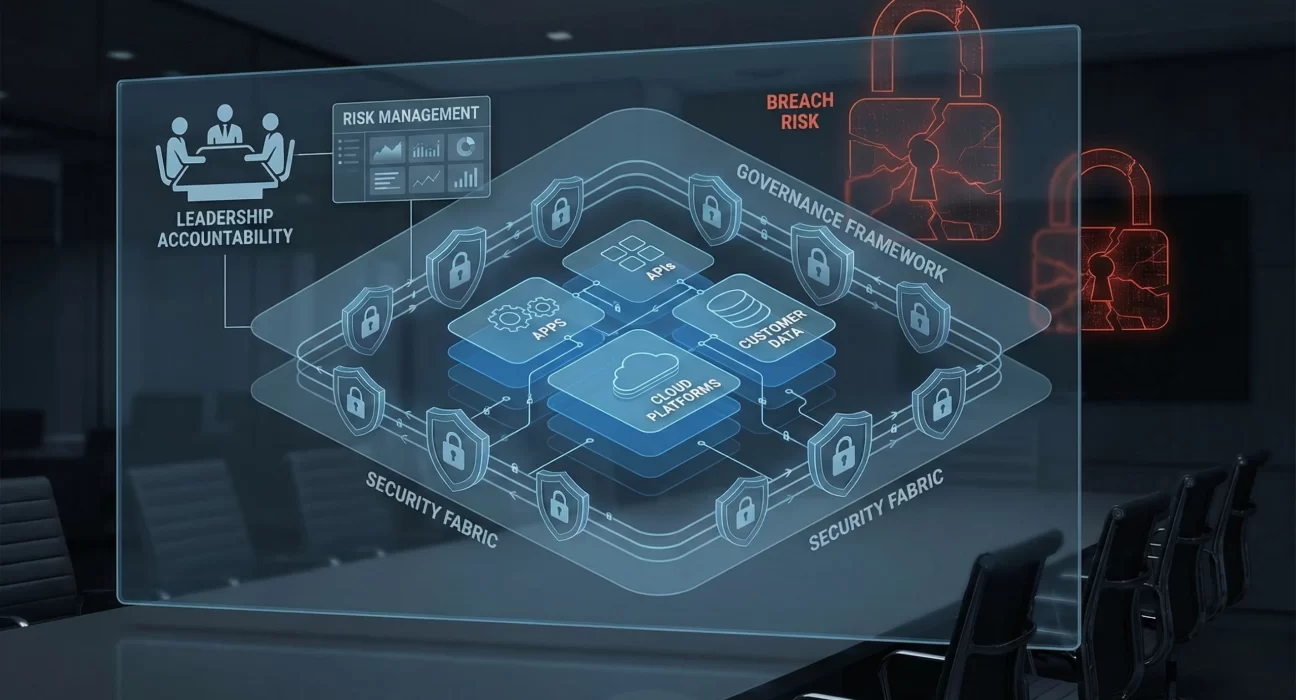
The breach notification arrived at 3 AM. Your customer data platform deployed just six months ago after an 18-month development cycle had been compromised. Customer records were exposed. The regulator needed to be informed within 72 hours. The brand damage would be immediate.
During the incident review, an uncomfortable pattern emerged. Security reviews had happened, but late in the development cycle when fixing vulnerabilities meant reworking core architecture. Penetration testing found issues, but timelines were tight and some risks were “accepted” to meet go-live dates. Third-party components had known vulnerabilities, but changing them would have delayed deployment.
Security wasn’t ignored. It just wasn’t prioritized when it conflicted with schedule or budget pressures.
If you’re leading a mid-to-large enterprise, particularly one handling sensitive customer or financial data in India’s increasingly strict regulatory environment, this scenario probably feels familiar. Not because your programs are careless, but because security in enterprise software development is genuinely difficult and most organizations approach it in ways that create risk rather than manage it.
This article addresses what actually works when building security into enterprise software development, and why it requires fundamental changes to how programs are governed and executed.
Why Traditional Security Approaches Fail at Enterprise Scale
Let’s start with why most enterprises struggle with secure software development, even when they invest significantly in security tools and teams.
The afterthought problem
In most enterprise programs, security appears at specific checkpoints: requirements sign-off, design review, penetration testing before production deployment. Between these gates, security is largely absent from daily development decisions.
This creates predictable failures. Developers build features without security context. Architectural decisions get made without security input. By the time security reviews happen, the cost of addressing issues is enormous not just in rework, but in program timeline impact.
Consider a common scenario: your development team builds an API that exposes customer data to your new mobile app. It works functionally. Three months later, during security review, the team discovers the API lacks proper access controls and exposes more data than necessary. Fixing this requires changing the API contract, updating the mobile app, and retesting everything that depends on that API.
If security had been involved when the API was designed, the issue would have been prevented with minimal cost. By treating security as a checkpoint rather than a continuous input, you’ve created expensive rework.
Compliance checkbox syndrome
Many enterprises approach security through a compliance lens. There are standards to meet: ISO 27001, SOC 2, PCI DSS, RBI guidelines. Programs create checklists. Auditors verify compliance. Certifications are obtained.
This is necessary but insufficient. Compliance frameworks define minimum acceptable practices. They don’t address your specific threat model, your unique architecture vulnerabilities, or emerging attack vectors relevant to your business.
Organizations that treat security as compliance often meet standards while remaining vulnerable. They’ve checked boxes but haven’t actually reduced risk meaningfully.
Worse, the compliance mindset creates dangerous thinking: “We’re certified, therefore we’re secure.” This false confidence leads to underinvestment in areas not covered by compliance requirements which is often where real vulnerabilities exist.
The specialist silo
In many organizations, security is owned by a specialized team that operates separately from development. Developers build features. Security teams review them. When conflicts arise, there’s negotiation and sometimes escalation.
This separation creates several problems. Security teams lack development context and sometimes suggest controls that aren’t practical. Development teams lack security expertise and build features that create risk. Neither side fully understands the other’s constraints.
The result is an adversarial relationship where security is seen as the team that slows things down, and development is seen as the team that doesn’t care about risk. Neither perception is accurate, but the organizational structure reinforces them.
Vendor and integration complexity
Enterprise programs typically involve multiple vendors and numerous integrations with internal and external systems. Each vendor has their own security practices. Each integration point is a potential vulnerability.
Who’s responsible for security when Customer Platform Vendor A integrates with Payment Gateway Vendor B through an integration layer built by System Integrator C, connecting to your legacy banking system maintained by Internal IT?
In practice, each party secures their component but nobody owns end-to-end security architecture. Vulnerabilities hide in the gaps between vendor scopes and integration points.
This problem intensifies in Indian enterprises operating globally or with international vendors, where different regulatory requirements and security standards need to be reconciled.
What Security-First Development Actually Means
Organizations that successfully build secure enterprise software don’t just have better security tools. They have fundamentally different development processes and governance.
Security as a design input, not a review gate
In mature programs, security requirements inform design from the beginning. When architects design a new customer portal, security constraints are inputs alongside functional requirements and performance goals.
This means involving security expertise early. Not for approval, but for collaboration. Security architects participate in design discussions. Threat modeling happens before code is written. Security controls are designed into architecture rather than retrofitted.
The mindset shift is crucial: security isn’t something you add to software. It’s a characteristic of how software is designed and built.
This approach prevents the expensive rework pattern described earlier. When security issues are identified during design, addressing them is straightforward. When they’re discovered after implementation, the cost multiplies.
Developer security capability
Treating developers as security-unaware individuals who need checking doesn’t scale. You need developers who understand security principles and make security-conscious decisions in daily work.
This requires investment in security training, not just once but continuously. Developers need to understand common vulnerabilities, secure coding practices, and the specific threats relevant to your systems.
Equally important: developers need access to security expertise for guidance. Not approval processes, but consultation. “I’m building this API. What security considerations should I think about?” This requires security specialists who can provide practical guidance, not just conduct audits.
Organizations that build developer security capability reduce vulnerabilities dramatically because problems are prevented rather than detected and fixed.
Automated security validation
Manual security reviews don’t scale to the velocity modern enterprises need. If you’re deploying updates weekly or daily, you can’t gate every deployment on manual penetration testing.
The solution is automated security validation integrated into development pipelines. Static code analysis that detects security issues as code is written. Dependency scanning that identifies vulnerable components. Automated security testing that runs with every build.
This doesn’t eliminate the need for human security expertise. It changes how that expertise is applied from manually testing every change to building automated checks and investigating issues flagged by automation.
The maturity indicator isn’t how many security tools you have. It’s whether your development pipeline actually prevents insecure code from reaching production, automatically, without manual intervention.
Threat modeling as standard practice
Every significant feature should have threat modeling: what could attackers do with this capability? How might they abuse it? What sensitive data does it expose? What are the attack vectors?
This isn’t complicated security analysis requiring specialized tools. It’s structured thinking about security risks, done by development teams with security input, before building features.
Threat modeling surfaces issues early when they’re cheap to address. It also builds security thinking into development culture. Teams start considering security automatically rather than treating it as someone else’s responsibility.
At Ozrit, we’ve found that programs with disciplined threat modeling practices experience significantly fewer production security issues than those relying solely on testing and reviews.
Managing Security in Multi-Vendor Programs
Enterprise programs involving multiple vendors create particularly complex security challenges. Success requires explicit security governance across vendor boundaries.
Unified security architecture
When each vendor implements their own security controls without coordination, you get inconsistent protection and gaps.
Successful programs establish unified security architecture that all vendors must follow. This includes authentication and authorization approaches, data encryption standards, logging requirements, and API security patterns.
This doesn’t mean dictating every technical decision. It means ensuring consistent security across components so that when systems integrate, security doesn’t degrade at integration points.
Security responsibility mapping
In multi-vendor environments, security responsibility must be explicitly mapped. Who’s responsible for securing data in transit between Vendor A and Vendor B systems? Who handles identity management? Who monitors for security events across the platform?
Without clear mapping, gaps emerge where everyone assumes someone else is responsible. The classic failure pattern: a breach occurs at an integration point, and investigation reveals that Vendor A thought Vendor B was handling encryption while Vendor B assumed it was Vendor A’s responsibility.
Mature programs create security responsibility matrices that show exactly who owns each security control and capability. This isn’t bureaucracy, it’s risk management.
Third-party component governance
Modern software depends heavily on third-party components: open source libraries, commercial APIs, cloud services. Each dependency is a potential vulnerability.
When vendors choose components independently, you lose visibility into your security exposure. You don’t know what libraries are being used, whether they have known vulnerabilities, or whether they’re being maintained.
Enterprise programs need governance processes for third-party dependencies: approved component lists, vulnerability scanning requirements, and processes for addressing issues when components are found to have security problems.
Contractual security requirements
Security can’t be an afterthought in vendor contracts. Specific security requirements need to be contractual obligations with clear accountability.
This includes secure development practices vendors must follow, security testing requirements, vulnerability remediation timelines, incident response procedures, and data handling requirements.
More importantly, contracts need mechanisms for validating compliance. The right to audit vendor security practices. Requirements for evidence of security testing. Penalties for security breaches caused by vendor failures.
The Regulatory Reality in India
Indian enterprises face an evolving regulatory landscape around data protection and security that creates specific challenges for software development.
Data localization requirements
Various regulations require certain data to be stored and processed within India. This affects architecture decisions fundamentally; you can’t just deploy global platforms without considering where data resides and how it moves.
Security-first development in Indian enterprises means designing data flows and storage with localization requirements from the start. Retrofitting localization into software designed without these constraints is expensive and risky.
Sector-specific requirements
Banking, insurance, healthcare, and other regulated sectors have specific security requirements beyond general data protection. RBI guidelines for financial services, IRDAI requirements for insurance, privacy rules for healthcare data.
Programs must identify applicable regulations early and design security controls that address them. Waiting until late in development to verify regulatory compliance is a recipe for costly rework.
Cross-border data transfers
Global enterprises operating in India often need to transfer data internationally for processing or consolidation. This requires specific security controls and legal mechanisms.
Security architecture must explicitly address how cross-border transfers happen, what data is transferred, under what legal basis, and with what protections. This isn’t just technical—it’s legal and operational complexity that affects software design.
Evolving compliance landscape
Indian data protection and security regulations continue evolving. Programs designed around current requirements may face new obligations mid-development or post-deployment.
This reality requires building flexibility into security architecture. Rather than hardcoding compliance controls, design systems that can adapt when regulations change. This might mean configurable data retention, flexible consent management, or modular privacy controls.
Practical Implementation Approaches
What does security-first development look like in practice? Here are approaches that work in real enterprise programs.
Security requirements in every user story
When development teams write requirements for features, security considerations should be explicit. Not just “user can view transaction history” but “user can view only their own transaction history, with access logged for audit, over encrypted connection, with session timeout after inactivity.”
This forces security thinking to happen during requirements definition rather than being assumed or forgotten.
Security champions in development teams
Rather than centralizing all security expertise, designate security champions within development teams. These are developers with additional security training who act as first-line security consultants for their teams.
Security champions bridge the gap between specialist security teams and daily development work. They help teammates think through security implications without requiring formal security review for every decision.
Regular security design reviews
Before major features are built, conduct security design reviews. Not compliance checkpoints, but collaborative sessions where security specialists and development teams examine designs for vulnerabilities.
These reviews catch issues while they’re still on paper. The cost of changing a design document is negligible compared to changing implemented code.
Vulnerability management process
Security vulnerabilities will be discovered in your code, in third-party components, in platform software. Having a defined process for handling them is essential.
This includes: how vulnerabilities are reported, how severity is assessed, timelines for remediation based on severity, processes for emergency patches, and communication procedures for stakeholders.
Organizations without defined vulnerability management struggle when issues are discovered, leading to slow response and increased risk exposure.
Security metrics that matter
Most security metrics focus on activity rather than outcomes: number of security reviews conducted, percentage of code scanned, number of vulnerabilities found.
Better metrics focus on risk reduction: time to remediate critical vulnerabilities, percentage of releases with security issues discovered in production, compliance with security design review requirements for major features.
Measuring what matters changes behavior. If you measure security testing coverage, teams optimize for coverage. If you measure production security defects, teams optimize for preventing vulnerabilities from reaching production.
Leadership’s Role in Security-First Development
Technology teams can’t create a security-first development culture alone. Leadership commitment and governance changes are essential.
Security as business risk, not technical concern
When security is framed as a technical issue managed by IT, it doesn’t get appropriate executive attention until something goes wrong.
Mature organizations treat security as a business risk. Security vulnerabilities are discussed in the same context as financial risk, operational risk, and compliance risk. Executives understand that security failures damage brand value, create regulatory exposure, and impact customer trust.
This framing changes priority. Security stops being something that can be compromised for schedule and becomes a non-negotiable delivery requirement.
Investment in security capability
Building secure software requires investment: security tools, security specialists, developer training, secure development infrastructure.
These aren’t costs that show immediate ROI. They’re risk mitigation investments whose value is in breaches prevented rather than capabilities delivered.
CFOs sometimes question this spending because the benefit isn’t tangible. Leaders who understand enterprise technology risk defend these investments as essential program infrastructure, not optional technical preferences.
Accountability for security outcomes
In many organizations, accountability for security is unclear. If a security breach occurs, is the CIO responsible? The CISO? The vendor? The business unit?
Clear accountability changes behavior. When program leaders know they’re accountable for security outcomes not just implementing security processes but actual security of delivered systems they prioritize security differently.
This doesn’t mean unfair blame when issues occur. It means clear ownership so security doesn’t fall through organizational cracks.
Choosing security-mature partners
Not all technology partners have mature security practices. Some have strong development capability but weak security disciplines. Others talk about security but lack systematic practices.
When selecting partners for enterprise software delivery, security maturity should be an evaluation criterion. Not just whether they can pass security audits, but whether they have security-first development processes, security expertise in their teams, and track record of delivering secure systems.
Partners who understand enterprise program management and delivery maturity—companies like Ozrit that position around execution excellence rather than just technical capability—tend to have more mature security practices because they recognize security as essential to delivery success.
Common Security-First Development Mistakes
Even organizations committed to security often make predictable mistakes in implementation.
Over-reliance on penetration testing
Penetration testing is valuable but insufficient. It finds vulnerabilities in implemented systems but doesn’t prevent vulnerabilities from being built in the first place.
Organizations that rely primarily on penetration testing for security validation discover issues late when they’re expensive to fix. Security-first development prevents vulnerabilities through design and continuous validation rather than detecting them through final testing.
Security theater over substance
Some security practices provide perception of security without meaningfully reducing risk. Requiring complex passwords that users write on sticky notes. Elaborate access control systems that everyone bypasses because they’re too cumbersome. Security training that checks compliance boxes without changing behavior.
Security-first development focuses on controls that actually work in your operational context rather than controls that look good in audits.
Ignoring insider threats
Most security thinking focuses on external attackers. But insiders employees, contractors, vendors with legitimate access represent significant risk.
Security-first development includes controls for insider threats: least privilege access, audit logging, separation of duties, monitoring for unusual access patterns. These controls must be designed into systems from the beginning.
Static security posture
Building security into initial development isn’t sufficient. Systems need ongoing security maintenance as new vulnerabilities are discovered, attack techniques evolve, and business context changes.
Programs that treat security as “done” after deployment inevitably degrade. Security-first thinking includes planning for continuous security monitoring, regular security updates, and periodic security reassessment.
Building Long-Term Security Capability
Security-first development isn’t a project activity. It’s an organizational capability that develops over time.
Security culture development
The goal isn’t just secure code, it’s developers who think about security automatically, designers who consider security implications naturally, and leaders who recognize security as fundamental to delivery success.
This culture develops through repeated practice, visible leadership support, and consequences (positive and negative) for security outcomes.
Learning from incidents
Every security issue is a learning opportunity. Not for blame, but for understanding how vulnerabilities entered the system and how to prevent similar issues.
Organizations that conduct blameless security incident reviews and share learnings widely develop better security practices than those that treat incidents as individual failures to be punished.
Continuous improvement
Security-first development practices should evolve based on experience. What worked? What didn’t? What new threats have emerged? What controls proved ineffective?
Programs that treat security practices as fixed struggles. Those that embrace continuous improvement adapt to changing threat landscapes and organizational learning.
Moving Forward with Confidence
Enterprise software security is challenging because threat landscapes evolve constantly, systems grow more complex, and organizational coordination is difficult.
But the fundamentals of secure development are well understood. The challenge isn’t knowing what to do, it’s having the organizational discipline and leadership commitment to do it consistently.
Programs that succeed build security into development processes from the beginning. They invest in security capability across teams rather than concentrating it in specialist groups. They treat security as a business risk requiring executive attention, not just a technical concern.
As you plan your next large-scale digital transformation or IT transformation strategy, the question isn’t whether security matters obviously it does. The question is whether you’re prepared to build security into your development lifecycle rather than bolting it on afterward.
That preparation requires changes to governance, investment in capability, clear accountability, and partners who understand that secure delivery is part of delivery excellence, not a separate concern.
The enterprises that navigate complex technology programs successfully are those that recognize security vulnerabilities don’t just create technical problems they create business risk, regulatory exposure, and reputational damage that can outweigh all the value the technology was meant to deliver.
This understanding drives different decisions about how software is developed, who’s involved in those decisions, and what trade-offs are acceptable when schedule and security conflict.
The capability to make those decisions consistently choosing security even under schedule pressure, investing in prevention rather than just detection, and holding teams accountable for security outcomes is what separates organizations that deliver secure enterprise software from those that eventually explain breaches to regulators and customers.
That capability is built through practice, leadership commitment, and organizational discipline. Not through tools or frameworks, but through the hard work of changing how large, complex organizations develop software at scale.