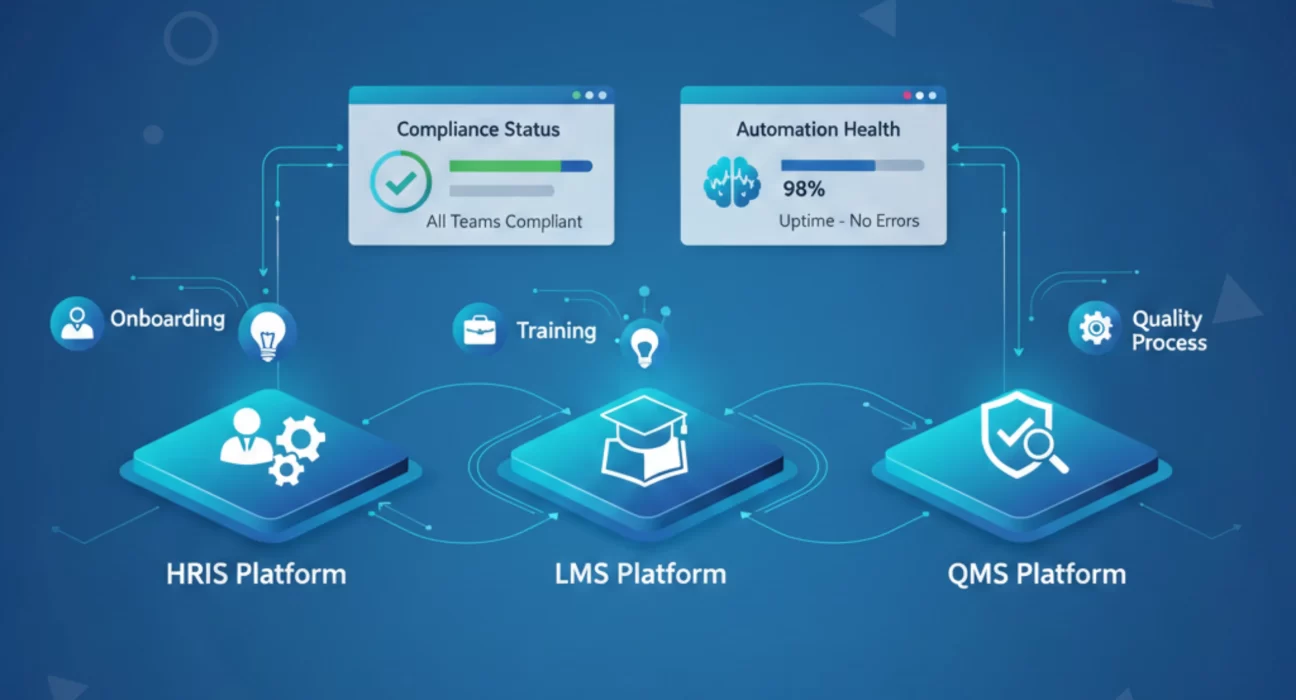
Most large enterprises run their operations across multiple disconnected systems. Your HRIS manages employee data and core HR processes. Your learning management system tracks training and certifications. Your quality management system handles compliance, audits, and corrective actions. Each system works adequately within its domain, but they don’t communicate with each other.
This creates enormous manual work coordinating information between systems. When someone joins the company, HR creates their employee record in the HRIS, then manually enrolls them in required training in the LMS, then manually adds them to relevant quality processes in the QMS. When someone changes roles, each system needs updating separately. When training expires or quality certifications lapse, someone manually cross-references the LMS or QMS against the HRIS to determine who needs remediation.
The inefficiency compounds at scale. In an organization with 10,000 employees and hundreds of role-based training requirements, managing this manually requires multiple full-time positions dedicated entirely to keeping systems synchronized. The work is tedious, error-prone, and prevents your staff from focusing on activities that actually require expertise.
More critically, the lack of integration creates compliance risk. Employees working in roles requiring specific training or certifications when their qualifications have lapsed. Quality processes continuing with team members who aren’t current on required procedures. Audit findings because required documentation exists in one system but wasn’t properly linked to employee records in another.
Workflow automation across these systems eliminates the manual coordination work and reduces compliance risk by ensuring data flows automatically between platforms. When someone is hired, the HRIS triggers automatic enrollment in role-appropriate training in the LMS and assignment to relevant quality processes in the QMS. When certifications expire, the systems coordinate remediation automatically. This isn’t about technology for its own sake. It’s about operational efficiency and risk reduction.
Why Cross-System Integration Is Hard
Integrating enterprise systems sounds straightforward in theory but involves substantial complexity in practice. Each system was designed to solve specific problems, uses different data models, and has different API capabilities.
Data model mismatches create immediate challenges. Your HRIS organizes information by employee, department, and role. Your LMS organizes by course, curriculum, and learning path. Your QMS organizes by process, procedure, and audit requirement. Mapping between these different models requires decisions about which system is authoritative for what data and how to represent the same information across different structures.
API limitations constrain what integration is possible. Some systems have robust APIs supporting comprehensive automation. Others have limited APIs requiring workarounds. Legacy systems might have no APIs at all, forcing integration through database access or file-based transfers. The integration approach needs to work within these constraints rather than assuming ideal technical capabilities.
Authentication and security add complexity. The integration needs credentials to access each system, but those credentials require careful management. Service accounts need appropriate permissions without being overly permissive. Credential rotation and secure storage add operational overhead. Security teams rightfully scrutinize any integration that moves data between systems.
Error handling determines whether integration is reliable or frustrating. What happens when the target system is unavailable? What happens when data validation fails? What happens when an API rate limit is hit? Poor error handling means integration failures cascade into user-facing problems or silent data inconsistencies that surface later as operational issues.
Change management across integrated systems becomes inherently complicated. When one system gets upgraded, integration might break. When data models change, mapping logic needs updates. When APIs evolve, integration code needs modification. Managing these changes across multiple systems and vendors requires coordination and governance that many organizations lack.
The Core Integration Patterns That Matter
Certain integration patterns deliver the most operational value in enterprise environments. These aren’t the only possible integrations, but they’re the ones that eliminate the most manual work and reduce the most risk.
Employee onboarding integration between HRIS and LMS automatically enrolls new hires in required training based on their role, department, and location. The HRIS knows when someone starts and what their role is. The LMS knows what training each role requires. Integration connects this information so enrollment happens automatically without HR staff manually creating training assignments.
Role change integration ensures that when someone moves to a new position, their training requirements update accordingly. The HRIS triggers the change. The LMS adds new required training and potentially removes old requirements that no longer apply. The QMS updates process assignments and access based on the new role. The employee receives clear communication about new requirements without HR coordinating across three systems manually.
Training completion integration flows certification and completion data back to the HRIS so it becomes part of the employee record. This makes training status visible to managers and creates complete documentation for compliance purposes. The HRIS becomes the system of record for employee qualifications without requiring duplicate data entry.
Expiration and remediation workflows monitor certification and training expiration dates and automatically trigger remediation. The LMS or QMS identifies upcoming expirations. The workflow system notifies employees and managers. If deadlines pass without completion, escalation happens automatically. This prevents people from working with expired qualifications because someone forgot to check expiration dates.
Quality process assignment integration ensures that employees are added to or removed from quality processes based on their current role and qualifications. When someone joins a manufacturing team, they’re automatically added to relevant quality procedures and audit schedules. When they transfer to another department, those assignments update. The QMS reflects current organizational reality without manual maintenance.
Compliance reporting integration pulls data from multiple systems into unified reports showing training status, certification currency, quality process compliance, and audit readiness. Regulators increasingly expect organizations to demonstrate compliance through data, not just through policies and procedures. Integrated reporting makes this feasible without manual data compilation.
Implementation Realities Nobody Mentions
Most integration projects encounter challenges that weren’t obvious during planning. Understanding these realities helps set appropriate expectations and plan accordingly.
The integration work takes longer than the simple technical implementation because organizational decisions need to be made about business rules, data ownership, exception handling, and process changes. These decisions often surface conflicting assumptions between departments about how things should work. Resolving these conflicts takes time and requires senior leadership engagement.
Data quality issues surface during integration implementation. The HRIS might have job titles that don’t match the role taxonomy in the LMS. The QMS might reference employee IDs that don’t exist in the HRIS. Department names might be inconsistent across systems. These quality issues need resolution before integration can work reliably. Organizations often discover data quality problems they didn’t know existed.
Performance and scalability become concerns when processing large volumes of data. An integration that works fine for 100 records might struggle with 10,000. API rate limits that weren’t an issue during testing become bottlenecks in production. These issues only surface under realistic load conditions.
Exception handling requires more thought than standard case automation. Most employees follow standard patterns, but there are always exceptions. Contract workers who need training but aren’t in the HRIS as regular employees. People who need training outside their standard role requirements. Grandfathered certifications from before the current tracking system existed. The integration needs to handle or accommodate these cases gracefully.
Ongoing maintenance requires attention after initial implementation. Systems get upgraded, business rules change, new requirements emerge. The integration needs corresponding updates or it slowly stops working correctly. Organizations often underestimate ongoing maintenance effort.
Governance That Makes Integration Sustainable
Integration isn’t a one-time project. It creates ongoing operational dependencies that require proper governance to remain functional and valuable.
Clear ownership for each integration defines who is responsible when issues occur. That owner coordinates across the teams managing different systems, makes decisions about changes, and ensures the integration continues meeting business needs. Without clear ownership, integration problems languish unresolved while teams debate whose responsibility they are.
Change coordination processes ensure that updates to any connected system include assessment of integration impacts. When the HRIS plans an upgrade, the team should evaluate whether the upgrade affects integration with LMS or QMS. When the LMS changes its data model, the integration logic might need corresponding updates. This coordination needs to be systematic, not ad hoc.
Monitoring and alerting detect integration failures quickly so they can be addressed before causing operational problems. Failed data transfers, API errors, data validation failures, performance degradation. These issues should generate alerts to appropriate technical teams. Many integration problems start small and grow if not detected and resolved promptly.
Regular review of integration effectiveness ensures the automation continues delivering intended value. Are training enrollments happening correctly? Are role changes triggering appropriate updates? Are compliance reports accurate and complete? Periodic validation catches drift between intended behavior and actual behavior.
Documentation of integration logic, data mappings, error handling, and business rules ensures that knowledge doesn’t reside solely with the individuals who built the integration. When people change roles or leave the organization, documented integration logic enables continuity. This documentation needs to be maintained as integration evolves.
The AI and Automation Opportunity
Modern integration platforms increasingly incorporate AI capabilities that add intelligence beyond simple data transfer. These capabilities deliver measurable value when applied thoughtfully to real business problems.
Intelligent routing can assign training or quality processes based on historical patterns and role similarities rather than just rigid rule-based assignment. The system learns which training typically benefits people in certain roles and suggests relevant content even when it’s not formally required. This helps with employee development while maintaining compliance for required training.
Predictive analytics identify employees at risk of certification lapse based on completion patterns and workload. Rather than just alerting when a deadline is approaching, the system predicts who is unlikely to complete on time and triggers early intervention. This prevents last-minute compliance issues.
Anomaly detection flags unusual patterns that might indicate problems. An employee suddenly requiring access to QMS processes outside their normal scope. Training completion rates dropping in a specific department. These patterns might indicate organizational changes that need accommodation or potential compliance issues requiring investigation.
Natural language processing can extract key information from unstructured quality documentation and link it to relevant training requirements. Quality incidents might reference procedures that have associated training. The system can automatically identify which employees need that training based on incident patterns.
The key is applying these capabilities where they solve real problems, not implementing AI because it’s trendy. The business case should be clear operational improvement or risk reduction, not just “using AI.”
How Ozrit Approaches Cross-System Integration
Ozrit’s work on enterprise system integration starts with mapping current workflows to understand where manual coordination between systems occurs, what data needs to flow between platforms, and which integrations will have the biggest impact on operational efficiency and compliance.
This mapping involves workshops with stakeholders from HR, learning and development, quality, compliance, and IT. The goal is understanding not just technical requirements but business context, compliance obligations, and operational constraints that affect integration design.
The design phase defines data flows, business rules, exception handling, monitoring requirements, and governance approach. This design includes detailed integration specifications that serve as blueprint for development and basis for testing.
A senior integration architect owns the technical program from design through production deployment and stabilization. They coordinate across teams managing different source systems, manage vendor relationships, make technical decisions, and ensure delivery stays on track. You work with one accountable leader rather than trying to coordinate multiple workstreams independently.
The implementation team typically includes six to ten people depending on scope. Integration developers who build connections between systems, business analysts who translate requirements into specifications, testing specialists who validate functionality and data accuracy, and operations engineers who ensure production readiness.
Realistic timelines for comprehensive cross-system integration programs run five to eight months from kickoff to production. This includes discovery, design, development, testing, and phased rollout. Organizations with particularly complex integration requirements, significant data quality remediation needs, or many systems might require longer.
The phased rollout approach implements integration for one department or employee population first, validates effectiveness, addresses discovered issues, then expands to additional populations. This reduces risk and allows learning from early phases to improve subsequent deployment.
Ozrit provides 24/7 support after integration goes live because system integration issues don’t respect business hours. When data flows break or errors occur, you need engineers who understand the architecture and can troubleshoot effectively. That means access to the team that designed and built the integration, not generic support staff reading documentation.
The goal is creating sustainable integration that continues delivering value as your organization and systems evolve. This requires proper initial design, solid implementation, thorough testing, comprehensive monitoring, and ongoing maintenance as systems change.
The Business Impact of Integration
The business case for cross-system integration combines efficiency gains, compliance risk reduction, and improved decision-making.
Time savings from eliminated manual work is the most tangible benefit. Staff time currently spent enrolling people in training, updating multiple systems when roles change, and compiling compliance reports gets freed up for work requiring actual expertise. At large scale, this represents multiple full-time positions worth of capacity.
Compliance risk reduction comes from ensuring required training and certifications remain current through automated monitoring and remediation. Audit findings decrease when systems enforce compliance automatically rather than relying on manual processes.
Decision quality improves when managers have unified visibility into team qualifications and compliance status. This information supports assignment decisions, development planning, and resource allocation. The data exists in separate systems today, but integration makes it accessible where decisions happen.
The investment in integration pays back through these benefits, but the timeline matters. Organizations should expect 18 to 24 months for payback through efficiency gains alone, with ongoing value from risk reduction and improved decision-making.
Your approach to system integration reflects whether you’re managing enterprise technology strategically or just accumulating disconnected tools. Organizations that invest in proper integration demonstrate that operational efficiency and data-driven decision-making matter. Organizations that tolerate disconnected systems accept the productivity losses, compliance risks, and limited visibility that fragmentation creates. The difference compounds daily across thousands of transactions and decisions.